


- Main
- Information
- Articles
Ironing machines for handling straight linen

16.01.2025
The characteristics of ironing machines for direct laundry, unlike those of washing machines or drying drums, are sometimes more than opaque to an experienced customer. There are many reasons for this situation.
In this article, with the help of specialists from TEXKEPRO, a supplier of various types and brands of ironing equipment, we will shed light on some basic issues.
Types of ironing machines
First of all, ironing machines for straight linen are divided into two types: grooved (mulch) type ironing machines and calender type machines. They differ in the principle of laundry processing. Unfortunately, there are no clear and concise terms in Russian that define these types of machines. There is approximately the same confusion in European languages. Let's look at the definitions.
Calender type machines

The name comes from the French word calandre. This is how the term sounds in Italian and Spanish. In English, this type of machine is often defined as belt ironer — belt ironing machine or roll heated ironer — ironing machine with a heated shaft. The main structural elements of the calenders are a metal heated shaft and a system of heat-resistant pressure belts.
The processed laundry is positioned motionless on a rotating shaft, pressed against it by needle-punched textile clamping bands. The calenders do not actually iron the laundry, but only dry it in a straightened form on a cylindrical heated metal surface. Moisture is removed from the internal volume of the machine. Calenders almost always have a wall-mounted design with laundry returning back to the feed side, which is both an advantage and a disadvantage of this type of machine.
Grooved (mulch) type machines

Their name came to us from the German language (mulden — gutter, mulda) and from countries such as Germany and Belgium, which are currently recognized leaders in the production of this type of equipment. In English, the definition of chest ironer is most often found. The basis of a muld ironing machine is a heated metal chute (which is essentially a large iron) and an elastic ironing shaft.
The laundry is placed on a rotating shaft with an air-permeable elastic heat-resistant textile surface, ironed and dried, moving along the metal ironing surface (gutters or mulches). The mold itself is pressed against the elastic shaft with high force, ensuring high ironing quality. Moisture is sucked out of the internal volume of the ironing shaft. The heated part is a fixed metal trough (muld). This design ensures the highest ironing quality, cost-effectiveness and productivity of mulch-type machines. That is, this type of machine actually rolls laundry over the surface of a huge iron, which is why these machines are called ironing rinks in Russian.
Thus, the main difference between calenders and ironing rollers (which is exactly what we will continue to call the types of ironing machines) is that the calenders are not ironed, but only the laundry pressed against it with ironing tapes is dried in a straightened form on the surface of the polished heated shaft. On the contrary, ironing rollers carry out exactly the ironing of linen, which is absolutely identical to ironing with an iron on an ironing table. The difference is that if the iron on the ironing table moves relative to the stationary surface of the table with the laundry lying on it, then in the roller the cylindrical ironing table (elastic ironing shaft) with the laundry moves (rotates) along the stationary ironing chute pressed against it with great effort. Both types of machines have been co-existing on the market for many decades, and they have their advantages and disadvantages, as well as their supporters and opponents.
Wall-mounted or walk-through ironing machine?
If you choose a low-performance ironing machine with a shaft diameter of up to 400-500 mm and an ironing working width of up to 175 cm, then all manufacturers of calenders or ironing rollers will offer you a wall-mounted version of the equipment. In this case, both the laundry is fed into the machine and it is received by the operator. The equipment is placed almost directly against the wall, and the car is serviced by one person. The specified size is actually the limit for the work of one efficient operator, even with very long arms. It is not for nothing that many manufacturers draw an invisible boundary in their product range in terms of the width of the ironing shaft of 1.6–1.8 meters.
If the wall-mounted ironing machine has a working width of more than the specified size and /or a shaft diameter of more than 400-500 mm, then one operator cannot handle such a machine. Thus, the opinion that a wall—mounted machine is always a single operator is greatly exaggerated. One operator can effectively work on a machine with a capacity of no more than 50 kg of laundry per hour with a working width of no more than 1.6 meters. Obviously, the wider machines will require at least two people.
In addition, there is often an argument in favor of a wall-mounted machine about supposedly significant savings in laundry room space. All this is absolutely true only for the above-mentioned standard size of small ironing machines. For machines with higher productivity (approaching, for example, 100 kg/hour) and with a wider working width, this argument does not work at all! The fact is that one or even two operators cannot effectively service the machine — they simply interfere with each other, as the laundry goes out "accordion" on the feed side into the receiving tray located under the feed conveyor. In order to fold the laundry, you need to take it out of the tray, spread it out on a separate table and only then fold it. Thus, for folding laundry after the wall-mounted machine, you need a separate table, which means additional laundry area for it and around it for the operator to work! That is, all the space savings have been nullified.… I would like to add that we deliberately do not touch on the topic of wall—mounted ironing machines with integrated longitudinal folding of laundry - this is a separate and difficult topic for conversation.…

That is why manufacturers of medium- and large-caliber ironing machines offer much more convenient pass-through machines as standard versions of the equipment. In this case, the laundry is fed from the front of the machine by one or two (for wide machines) operators, and the reception and folding is performed by another operator on a compact receiving table at the back of the machine. At the same time, he does not bend down for each item and does not transfer it to a separate table — and it is convenient to do the work, and the quality does not suffer, and the technical performance of the machine can be used 100%!
Pros and cons of ironing rollers and calenders
Ironing rinks
+ They provide the highest quality of ironing.
+ Medium-performance models, as a rule, come in both wall-mounted and pass-through versions.
+ They are more economical — almost all energy is spent on drying clothes without loss, the heated mulch is well insulated, effective moisture removal is provided by a low-power exhaust fan from the ironing shaft.
+ A wide range of models. The rollers cover the entire range of sizes and capacities — from the smallest semi-professional mini-rinks to huge multi-roll industrial ironing lines.
– They have a higher price compared to calenders.
– They require operators to use it carefully (the mulch can be scratched by foreign solids) and follow the procedures for cleaning/waxing the surface of the mulch.
– They are sensitive to the input humidity of the laundry — they are not intended for laundry that is too wet (more than 60-70% of the residual humidity).
Calenders
+ Low cost of equipment compared to ironing rinks.
+ They are insensitive to the incoming humidity of the laundry.
– The quality of ironing is relatively low — there may be traces of the gaps between the ironing tapes and the separating tapes on the linen.
– Low efficiency — the heated shaft with the ironing belt system cannot be thermally insulated in principle, and a considerable part of the energy is simply removed by the exhaust fan into the ventilation.
– The high cost of replacing ironing belts and cleaning the ironing shaft (a problem when washing in hard water and using low-quality laundry preparations).
– A relatively narrow model range. Most manufacturers have calenders available only in the medium performance range, and there are only wall—mounted models - there are no small models, nor, as a rule, large ones.

Let's take a closer look at the Stefab equipment options offered by our company for ironing straight linen.
Mini laundries

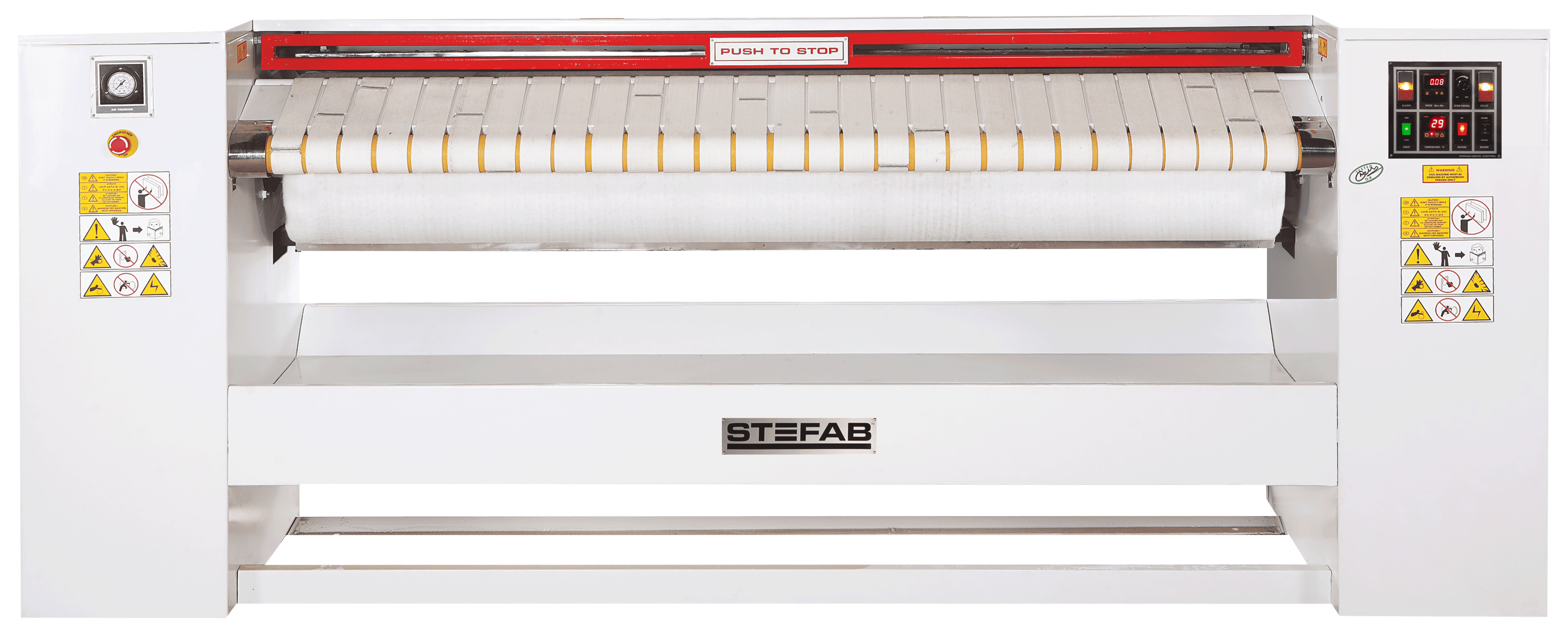
The small ironing rollers FRE 25-150 and FRE 38-200 are ideal for mini-laundries. The latter of them has not only a fully "grown" diameter of the 380 mm ironing shaft, but also comes in the FRS 38-200 version with steam heating.
Despite the small caliber of the machines, like all Stefab equipment, these models are manufactured in a high-quality basic configuration. The elastic layer of the ironing shaft consists of Spring Press springs and an outer layer of heat-resistant latex. A gear motor controlled by an inverter is responsible for the rotation of the shaft. It is a quiet, reliable design with the ability to reverse rotation, which does not require maintenance. Digital control of temperature and shaft rotation speed make the rollers simple and convenient to use. The pneumatic cushions ensure a uniform pressing of the mulch to the ironing shaft.

Even small Stefab ironing rollers are reliable workhorses and allow you to achieve ironing performance of 40 and 70 kg/hour with an input humidity of 25%.
The FXE 15 and FXE 25 washing and wringing machines (15 and 25 kg load, respectively) and the DRE 15 and DRE 30 drying drums (15 and 30 kg load) can be recommended for the mini-laundry kit. Both washing machines and dryers can be supplied in steam-heated versions.
Features of STEFAB ironing rollers

STEFAB's large electric—heated ironing rollers have a unique option - a thermal oil circulation pump. The basic design of the mulch has oil pockets in which heating elements (heating elements) are immersed. The pockets communicate with each other, which ensures a small circulation of oil inside the mulch under the influence of emerging temperature gradients. The entire volume of thermal oil is sealed, which eliminates the interaction of heated oil with oxygen, its oxidation and degradation. This ensures long service life and low cost of ownership of the equipment.
One of the important, but not obvious and difficult-to-control parameters of the operation of any ironing machine is the uniformity of heating of the ironing surface. The higher it is, the lower the risk of burning laundry on a locally overheated surface or getting wet laundry at the outlet. The option of an integrated circulation pump in the Stefab FE 53 and FRE 53 rollers creates a forced circulation of thermal oil inside the entire mulch, which ensures maximum heat transfer and eliminates local surface overheating. All this ensures maximum ironing quality and increases the performance of the rink.

It should be added that the circulation pump is standard equipment for the largest Stefab ironing rollers with a shaft diameter of 830 mm. High technical characteristics, along with an industrially rigid design and an affordable price, make the offer of these machines uncontested.
Medium-capacity laundries

In this and probably the most widespread segment of laundries, Stefab offers various versions of ironing rollers with shaft diameters of 530 and 830 mm and working widths of 300 and 330 mm, allowing ironing in two lines. All models have three heating options: electric, steam, and, most high-performance, with an external coolant (thermal oil). Rollers with a shaft of 530 mm are available in wall-mounted or pass-through versions. All the design characteristics described above for small rollers are typical for these Stefab models.
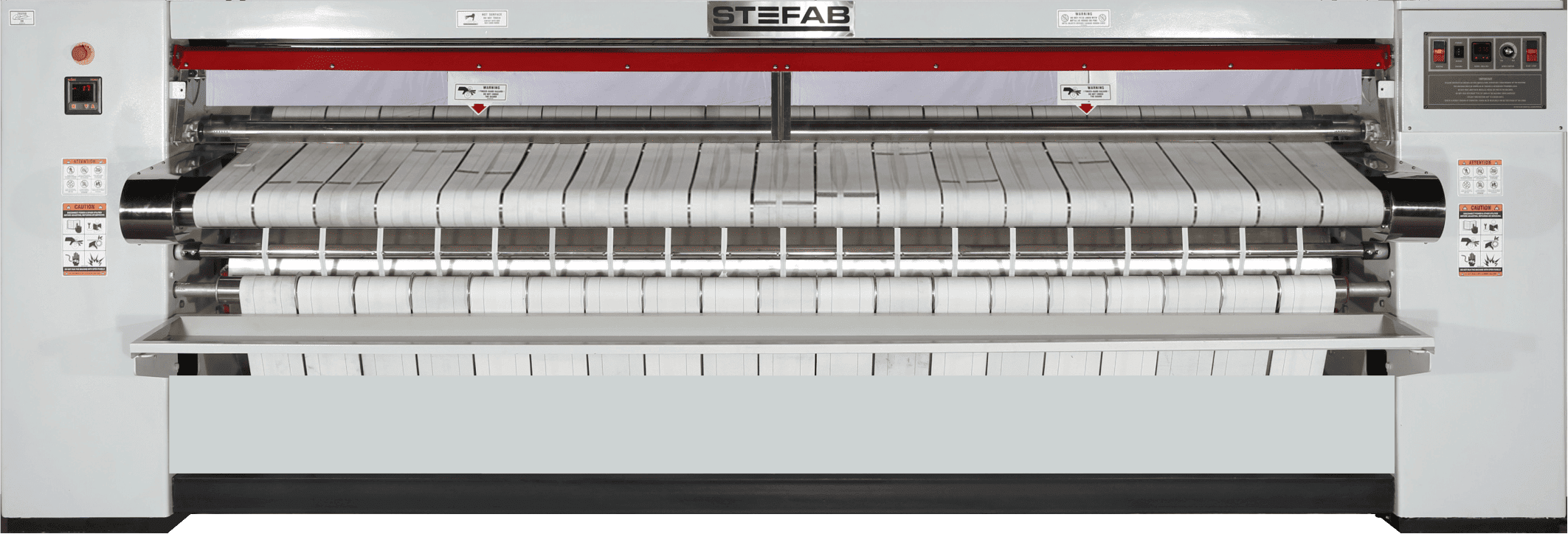
Fans of calenders are offered large models of the Stefab series R 80 (pass-through) and RL 80 (wall-mounted). Electric, steam and gas heating is possible. The considerable size of the shaft (diameter 800 mm, working width up to 330 cm) allows for high productivity of laundry processing. And the low cost of the equipment makes it affordable for most customers.
The AXE 30 and AXE 60 washing machines (30 and 60 kg load, respectively) and the DRE 30 and DRE 60 drying drums (30 and 60 kg load) are suitable for completing such laundries. Washing machines can be supplied in versions with steam or combined steam-electric heating. But for Stefab dryers, you can choose from six different types of heating! It should be added that washing machines have free programming and can optimally work out any technology.
Industrial laundries
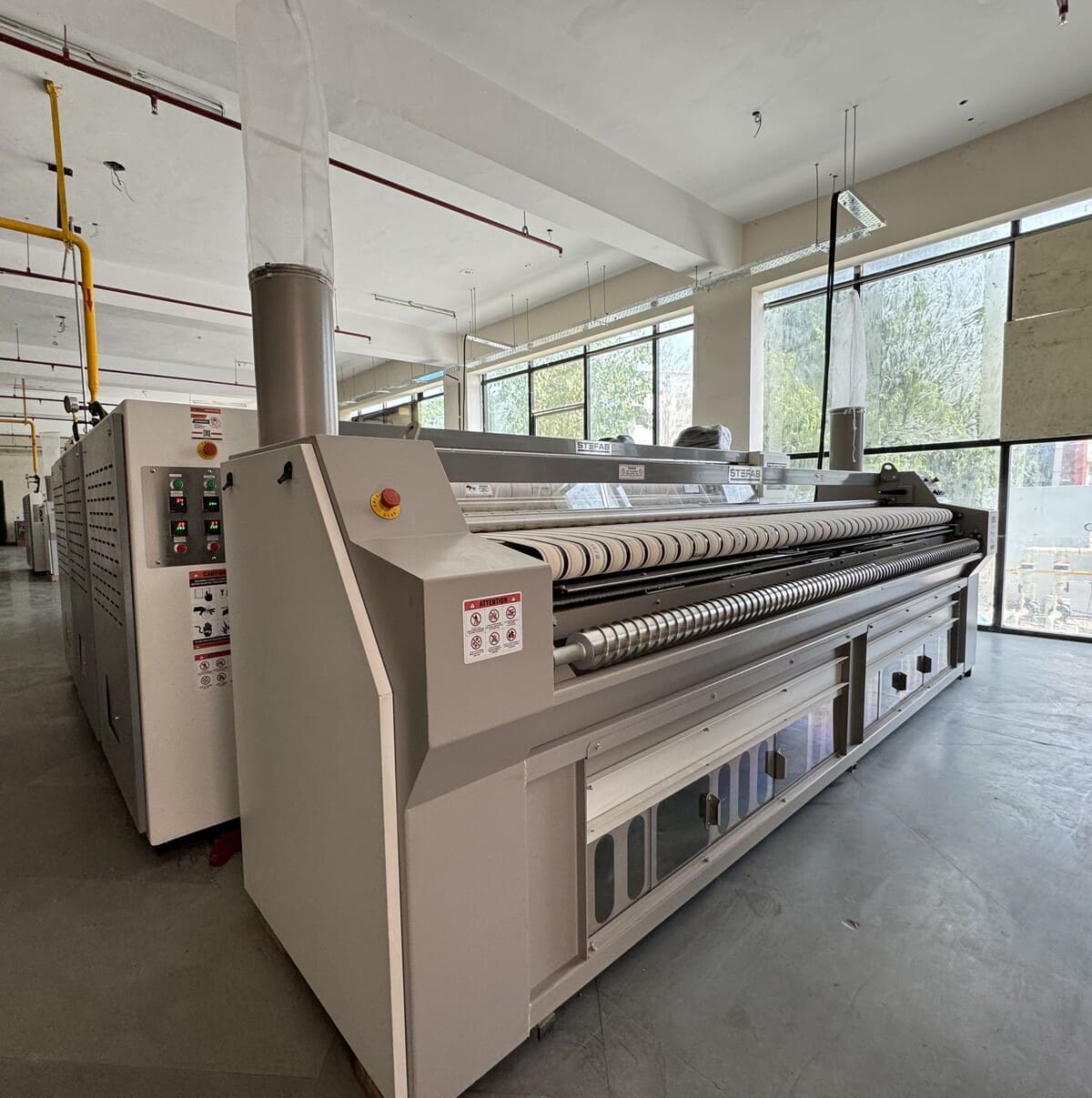
In this segment of laundries, TEXKEPRO offers Stefab calenders and ironing rollers in two- or three-roll designs. The ironing machines themselves can be retrofitted with a FL 330 folding machine, a STK 80 stacker and an FD 330 feeding machine, which speeds up the work of operators on feeding laundry due to a vacuum conveyor and a screw distributing device. As a rule, such ironing lines have steam or gas heating.

An important feature of the large Stefanovsky ironing machines is the "Add-a-Roll" principle. The calenders and rollers are designed in such a way that the user, starting with a single-roll pass-through ironing machine, can in the future order an additional ironing section, a folding machine, a stacker or a feeding machine. Electronic synchronization of all machines makes it easy to do this. Stefab's "Add-a-Roll" principle ensures minimal costs when it comes to increasing laundry productivity.
In addition to the above-mentioned machines, Stefab offers 120 kg washing machines and dryers (AX 120 and DR 120) with various heating options (electric, steam, thermal oil, gas) as part of such high-performance laundries.

It is also necessary to add that barrier models of the Stefab BX series with a load of 30, 60 and 100 kg can be introduced into any laundry for washing the medical range of laundry.
You can always get detailed advice and complete information about laundry equipment and more from TEXKEPRO specialists.
Dmitry KOLOTKOV
TEXKEPRO Company
bodys.: +7 (985) 992-79-76, www.texcare.ru
Gallery




Documents
