Everyone agrees that it is bad to underload washing machines. Therefore, today it is not good to overload them either...
29/07/2026
High load does not mean high performance.
In conditions of high laundry load, there is an understandable desire to put more laundry in the washing machine. It seems that the extra pounds in the drum will increase productivity. But in practice, the result is the opposite: overloading an industrial washing machine reduces the quality of washing, increases resource consumption, and accelerates the wear of both equipment and textiles.

There should be a "free" place in the drum.
Washing is not just the static contact of laundry with water and detergents. One of the most important factors is the mechanical effect.
The right technology is a balance of temperature, time, and mechanics.physical effects and chemistry.
Overloading disrupts this balance.
When the drum rotates, the textiles must move, rise to a certain height and fall. It is this movement that provides the necessary mechanics of the process and helps to remove impurities. It is based on this movement that technological maps are created and chemical consumption rates are set.
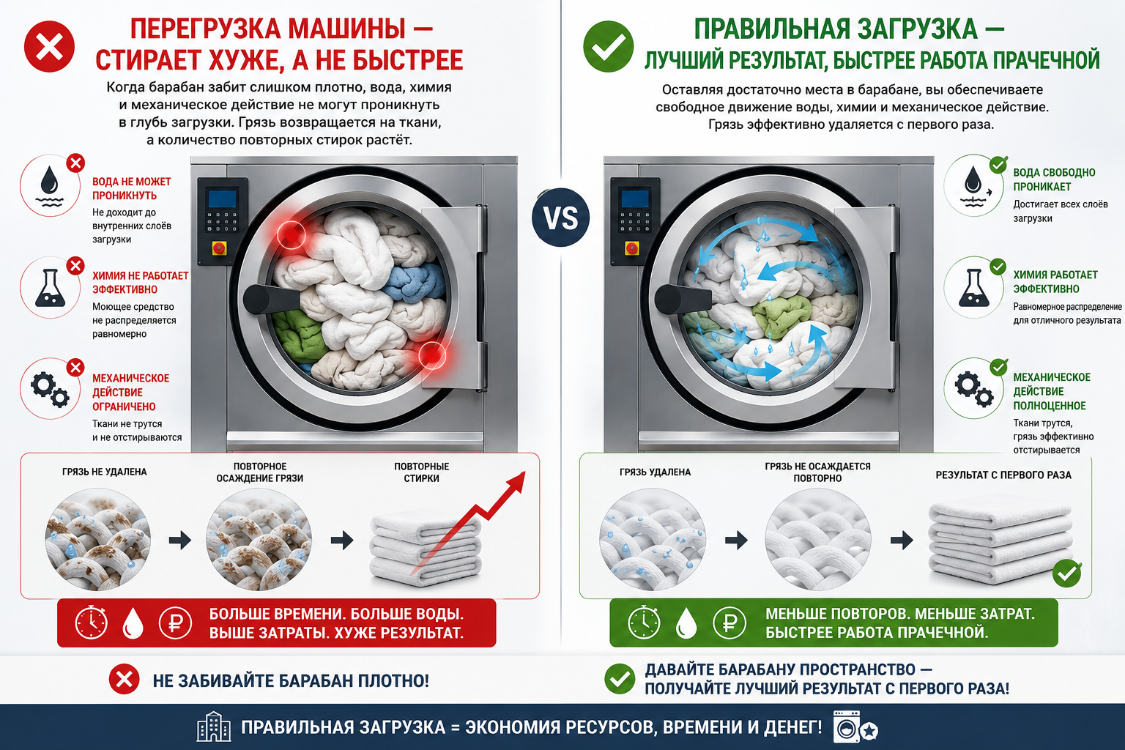
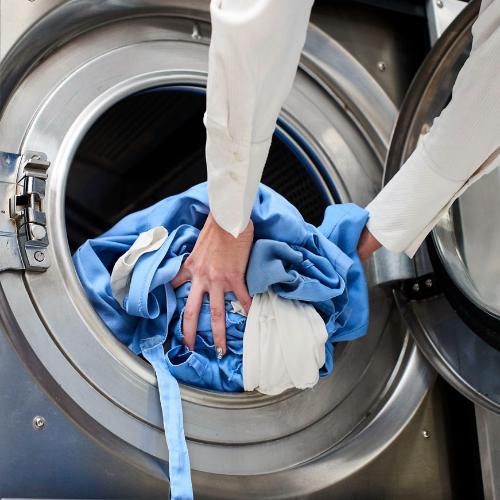
And if the car is overloaded, then the laundry turns out to be too tightly pressed against each other. Instead of free movement, an almost uniform mass of textiles is formed inside the drum. The mechanical impact decreases dramatically, and with it the washing efficiency decreases dramatically.
The working solution must penetrate everywhere.
When properly loaded, water and detergent solution flow freely through the laundry, ensuring uniform wetting, distribution of the components of the washing system and transit of their products.
Overloading impairs the circulation of the solution. In a dense mass of textiles, areas may occur where wetting, the action of detergents and subsequent rinsing are less effective.
This is especially critical for heavily soiled laundry, workwear, restaurant and medical textiles, where washing requires not just visual cleanliness, but a stable and reproducible technological result.
The equipment is suffering.
Systematic overload is also an additional burden on the washing machine.
The mass of the rotating drum increases, and dynamic loads increase during laundry distribution and spin. The situation is especially dangerous when overloaded laundry is distributed unevenly and there is a strong imbalance.
As a result, the drive, bearings, suspension elements and other mechanical components of the machine receive additional load. What seems like an obvious way to increase productivity will eventually result in additional maintenance and repair costs.
Overloading reduces the actual performance.
The main mistake is to evaluate the laundry's performance only by the number of kilograms placed in the drum.
The extra pounds in one cycle really give the impression of increased productivity. But because of this, the quality of washing deteriorates and some of the laundry has to be washed. And repeated washing means another cycle of machine operation, additional consumption of water, energy, detergents and staff working time.
Therefore, maximum load and maximum performance are not the same thing at all.
It's not just the kilograms that matter.
It should be borne in mind that the nominal load of an industrial washing machine is usually indicated by the weight of dry laundry, however, not only the weight is important for the technologist, but also the actual degree of filling of the drum with a specific assortment. Different products have different volume and water retention capacity. Terry towels, bathrobes, bed linen, overalls and light textiles behave completely differently in the drum. Therefore, when choosing a load, it is necessary to take into account the type of textile, its volume, the degree of contamination and the requirements of a specific washing program.
That is why professional operation of the equipment does not involve the desire to fill the drum "to capacity" every time, but compliance with the recommended loading and technological parameters.
You need to save money. But not in the empty space in the drum.
A few free kilograms of nominal load is sometimes perceived as lost productivity. In fact, the free space inside the drum is part of the washing technology.
It is necessary for the movement of laundry, the circulation of detergent solution, effective rinsing and uniform distribution of textiles.
So please don't try to get more out of the washing machine by loading more laundry into it. Get more with the right technology, optimal loading, and consistent quality from the first cycle.
It's cheaper, more reliable, and ultimately more productive because
infusionThe maximum productivity of a laundry room is not the maximum number of kilograms placed in a machine, but the maximum number of kilograms.the quality of processed textiles obtained the first time with optimal consumption of water, energy, chemicals and equipment resources.
If you are planning to modernize laundry, dry cleaning or want to improve the efficiency of existing technologies, TEXKEPRO specialists and our partners in the EAEU countries will help you find optimal solutions and develop a practical plan for the introduction of modern washing, dry cleaning and aqua cleaning technologies.
Contact us to bring the quality of textile processing to a new level today.
To get more information, you can write to us at info@texcare.ru or call:
8 800 222 57 55 — free multi-channel long-distance number;
8 495 730 57 55 — multi-channel Moscow number;
8 926 209 57 55 — a convenient mobile number.
In conditions of high laundry load, there is an understandable desire to put more laundry in the washing machine. It seems that the extra pounds in the drum will increase productivity. But in practice, the result is the opposite: overloading an industrial washing machine reduces the quality of washing, increases resource consumption, and accelerates the wear of both equipment and textiles.
There should be a "free" place in the drum.
Washing is not just the static contact of laundry with water and detergents. One of the most important factors is the mechanical effect.
The right technology is a balance of temperature, time, and mechanics.physical effects and chemistry.
Overloading disrupts this balance.
When the drum rotates, the textiles must move, rise to a certain height and fall. It is this movement that provides the necessary mechanics of the process and helps to remove impurities. It is based on this movement that technological maps are created and chemical consumption rates are set.
And if the car is overloaded, then the laundry turns out to be too tightly pressed against each other. Instead of free movement, an almost uniform mass of textiles is formed inside the drum. The mechanical impact decreases dramatically, and with it the washing efficiency decreases dramatically.
The working solution must penetrate everywhere.
When properly loaded, water and detergent solution flow freely through the laundry, ensuring uniform wetting, distribution of the components of the washing system and transit of their products.
Overloading impairs the circulation of the solution. In a dense mass of textiles, areas may occur where wetting, the action of detergents and subsequent rinsing are less effective.
This is especially critical for heavily soiled laundry, workwear, restaurant and medical textiles, where washing requires not just visual cleanliness, but a stable and reproducible technological result.
The equipment is suffering.
Systematic overload is also an additional burden on the washing machine.
The mass of the rotating drum increases, and dynamic loads increase during laundry distribution and spin. The situation is especially dangerous when overloaded laundry is distributed unevenly and there is a strong imbalance.
As a result, the drive, bearings, suspension elements and other mechanical components of the machine receive additional load. What seems like an obvious way to increase productivity will eventually result in additional maintenance and repair costs.
Overloading reduces the actual performance.
The main mistake is to evaluate the laundry's performance only by the number of kilograms placed in the drum.
The extra pounds in one cycle really give the impression of increased productivity. But because of this, the quality of washing deteriorates and some of the laundry has to be washed. And repeated washing means another cycle of machine operation, additional consumption of water, energy, detergents and staff working time.
Therefore, maximum load and maximum performance are not the same thing at all.
It's not just the kilograms that matter.
It should be borne in mind that the nominal load of an industrial washing machine is usually indicated by the weight of dry laundry, however, not only the weight is important for the technologist, but also the actual degree of filling of the drum with a specific assortment. Different products have different volume and water retention capacity. Terry towels, bathrobes, bed linen, overalls and light textiles behave completely differently in the drum. Therefore, when choosing a load, it is necessary to take into account the type of textile, its volume, the degree of contamination and the requirements of a specific washing program.
That is why professional operation of the equipment does not involve the desire to fill the drum "to capacity" every time, but compliance with the recommended loading and technological parameters.
You need to save money. But not in the empty space in the drum.
A few free kilograms of nominal load is sometimes perceived as lost productivity. In fact, the free space inside the drum is part of the washing technology.
It is necessary for the movement of laundry, the circulation of detergent solution, effective rinsing and uniform distribution of textiles.
So please don't try to get more out of the washing machine by loading more laundry into it. Get more with the right technology, optimal loading, and consistent quality from the first cycle.
It's cheaper, more reliable, and ultimately more productive because
infusionThe maximum productivity of a laundry room is not the maximum number of kilograms placed in a machine, but the maximum number of kilograms.the quality of processed textiles obtained the first time with optimal consumption of water, energy, chemicals and equipment resources.
If you are planning to modernize laundry, dry cleaning or want to improve the efficiency of existing technologies, TEXKEPRO specialists and our partners in the EAEU countries will help you find optimal solutions and develop a practical plan for the introduction of modern washing, dry cleaning and aqua cleaning technologies.
Contact us to bring the quality of textile processing to a new level today.
To get more information, you can write to us at info@texcare.ru or call:
8 800 222 57 55 — free multi-channel long-distance number;
8 495 730 57 55 — multi-channel Moscow number;
8 926 209 57 55 — a convenient mobile number.
Gallery