


How to design a laundry room correctly. Part One

As in any other professional field, working on a business project requires not only equipment suppliers, designers, and construction contractors, but also, above all, a thorough approach, involved participation, and full immersion in the project on the part of the customer. And not just on the part of the customer in the person of the contractor or the project manager, but the owner of the future enterprise.
Dmitry Kolotkov, manager of industrial laundries and product manager of STEFAB at TEXKEPRO, explains how to choose the right laundry equipment and not to mess up.
INTRODUCTORY DATA
The success of any enterprise is a clear understanding by the owner of its goals. No one will be able to find the perfect set of equipment for you if you, as a customer, do not understand yourself what you want to build. A striking example of the difference in the approach to the organization and operation of the enterprise is who is the client of the planned laundry. If you are a hospital laundromat, and even with infectious diseases departments, then, all other things being equal, the important nuances for you will be the delicate processing of laundry (which will ensure a long service life) and full compliance with the requirements of combating nosocomial infections.
So what information do the specialists need from the customer for the correct calculation of productivity and optimal selection of equipment?
LAUNDRIES BY TYPE OF BUSINESS ORGANIZATION
There are three main types of laundries according to this criterion. This:
- Own laundries or OPL (on-premise laundry). The direct literal translation into Russian (local, intra-house) is not entirely clear. The main thing here is that the laundry is only a part (division) of some large enterprise and processes its laundry. That is, OPL = the company's own laundry. And it doesn't matter what kind of organization it is – it can be a hotel, a fitness club, a hospital, any industrial enterprise or an ocean cruise ship. Such laundries are created for several reasons. This:
- the desire to reduce the cost of washing your own laundry (processing at cost);
- the need for full control over the quality of washing and finishing of laundry;
- the importance of ensuring the correct technical process of laundry processing in order to maximize the prolongation of its life and / or the preservation of its special properties and, of course,,
- the inability to use third-party laundry services.
Obviously, the OPL of various enterprises will differ greatly from each other, but the principle of production organization, nevertheless, will be the same for all of them.
- Commercial laundries. Commercial laundries work with third-party clients and provide laundry services for money. That is, it is the opposite of OPL. Let's face it, the safety of customers' laundry is unimportant in such a laundry. High temperatures and aggressive chemicals can be used. Of course, there are exceptions, but it is not necessary to expect that such enterprises employ qualified personnel, use the best equipment and advanced technologies / preparations for washing. The main thing is that customers would pay and not be very indignant about the quality of the service provided. All this has a special impact, in particular, on the choice of equipment for commercial laundries.
- Self-service laundries or Coin-op laundries. This is the third type of laundries that actually rent out a laundry room and their laundry equipment to customers. An important feature of this equipment is its ability to collect banknotes from customers in any form. If you look at the technical side of cars, then in essence, they differ very little from household appliances. The owners of such laundries rarely think about washing technologies – it is much more important to install a vending machine for coffee, sandwiches and chocolates on the available area. But even here, it is not necessary to generalize, there may be various options.
How much should I wash?
First of all, it is the required performance per unit of time. Per year, per month, per day. In any case, experts should calculate the hourly productivity of the laundry for each type of laundry.
What should I wash?
The calculated productivity of linen processing cannot be considered in isolation from the type of linen (bed, restaurant, terry cloth, workwear, ...), its composition (cotton, blending, other nuances), and the type of contamination. Combinations of these three parameters (type-composition-contamination) not only affect the productivity of the laundry, but also create certain combinations of the necessary equipment for its processing. For example, the size of the sheets and duvet covers has a significant impact on the choice of ironing equipment for straight linen. It would be very foolish to purchase an ironing roller or a calender with a working width of 250 cm if a significant proportion of straight linen is 260 cm in size. And it doesn't matter at all what the second size of the sheet will be – 220 or 300 cm.
Where to do laundry?
Under this issue, it is necessary to consider comprehensively all the features of the future laundry facilities. These include the area, the ways in and out of the laundry, the need to store dirty and clean laundry, the possibility of redeveloping the premises, the need for utility rooms and staff quarters.
But the main thing is not even square meters and the ability to add dimensional equipment to them, but the availability of the necessary energy resources. First of all, there is electricity, water (cold, hot, softened), and ventilation. A very important advantage will be the presence of gas and/or steam (its pressure). There are usually no issues with draining water, except in cases where the laundry is supposed to be located on the territory of a water protection zone. Then the future laundry is immediately considered not as a set of abstract equipment, but as a technological process in which the drugs used in it and their safety for the operation of the facility's sewage treatment plants are immediately clear.
OTHER NUANCES
There are a lot of them. And there may be several possible solutions. Unfortunately, the optimal one can only be offered by a highly qualified specialist of the supplier company. His high-quality work is able to save the customer a very large sum when purchasing equipment and ensure low operating costs (low cost of ownership).
As a simple example, I'll give the following. It was necessary to completely reconstruct a large enough laundry room for processing hospital linen. A real productivity of 1,500 kg per 12-hour work shift was required. The linen itself was cotton and heavily soiled, but there was no infected linen or baby linen, meaning barrier washing machines were not needed.
The nuance of the laundry was that the laundry was delivered to the laundry from the departments in small batches of 15-25 kg or even less. And these batches had to be washed separately from each other as they arrived. For this reason, the machines often had to be started underloaded, which led to a decrease in the productivity of the laundry as a whole, overspending of water and detergents.
WHY IS A FULL LOAD OF MACHINES BENEFICIAL?
There is a misconception that modern smart washing machines can pour water in direct proportion to the amount of laundry stored in them. For example, half load = half water. This means that washing machines can spend half as much detergent and half as much energy on washing.
So that's not it! Of course, there are machines that are equipped with real built-in scales that measure the weight of loaded laundry, which have flow meters for water and liquid detergents and a smart processor that controls all this, but…
In real life, such machines are not found. At least in Russia. First of all, they are expensive. Secondly, they are very capricious in their work, configuration, programming and maintenance. And thirdly, and most importantly, they cannot provide a direct proportion between the load of laundry and the consumption of water, chemicals and energy. Why is a story for a separate article.
Just believe that you should always try to load the car according to its actual load. It is defined in kilograms as a tenth of the volume of the drum in liters and necessarily taking into account the reducing technological coefficient. It depends on the type, density and composition of the laundry, as well as on its contamination. And, this is important, it does not depend on the make or model of the car.
That is, even for the most optimistic case, when the technological coefficient is 1, 40 (no more than) kg of laundry should be placed in the 400-liter drum of the washing machine. In this case, you will receive high-quality washing and the highest possible equipment performance with the lowest specific consumption of energy, water and chemicals.
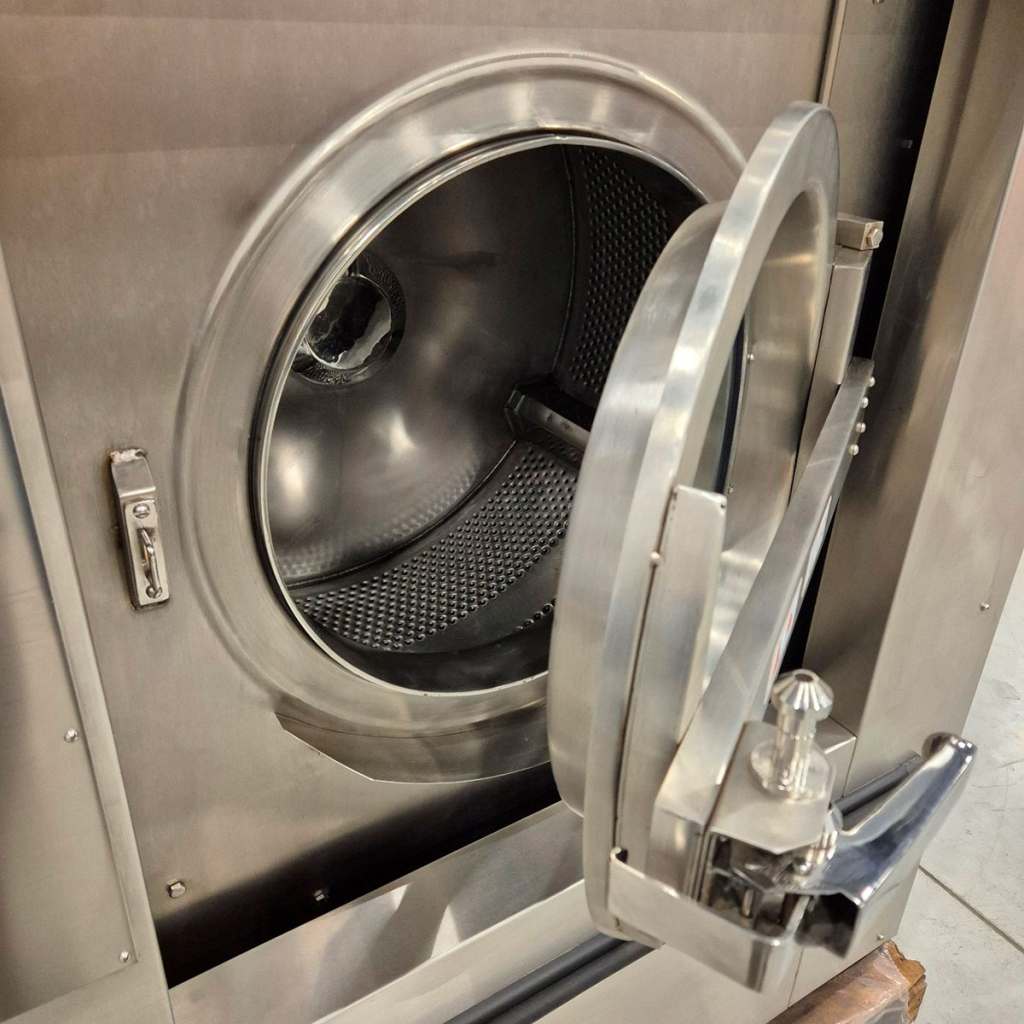
Previous personal experience told the customer that the problem is solved by installing 30kg machines in the amount of 8 pcs. + two 15kg machines. And it was technically correct. But another solution was proposed. Instead of 8x30kg + 2x15kg, his laundry room was equipped with four 60 kg machines and one 30 kg machine. Plus, not counting the drying drums and a powerful calender, a set of Thermopatch equipment and supplies for permanent labeling. What did it do?
- An empty space was freed up in the laundry room, which was occupied by a water treatment plant. The availability of soft water made it possible to improve the quality of washing, reduce detergent consumption and extend the life of the washing heaters.
- The cost of a set of basic equipment has decreased – one 60kg machine is always cheaper than its two 30kg sisters. And as a bonus, it also washes better / faster due to the larger diameter of its drum and better washing mechanics.
- All the linen was marked according to its affiliation to the hospital departments and the date of its commissioning. Linen stopped getting tangled and lost between departments, the hospital was able to ensure objective control over linen and compliance with standards for its service life. Later, thanks to the constant labeling, the workwear became personalized, which improved the appearance and mood of the medical staff during the transition to modern, high-quality uniforms.
- By increasing the number of downloads, the number of manual operations decreased, which led to lower personnel costs. But the main thing is that due to strict compliance with the size of the loads and the optimal dosage of detergents, the laundry began to work more rhythmically and better.
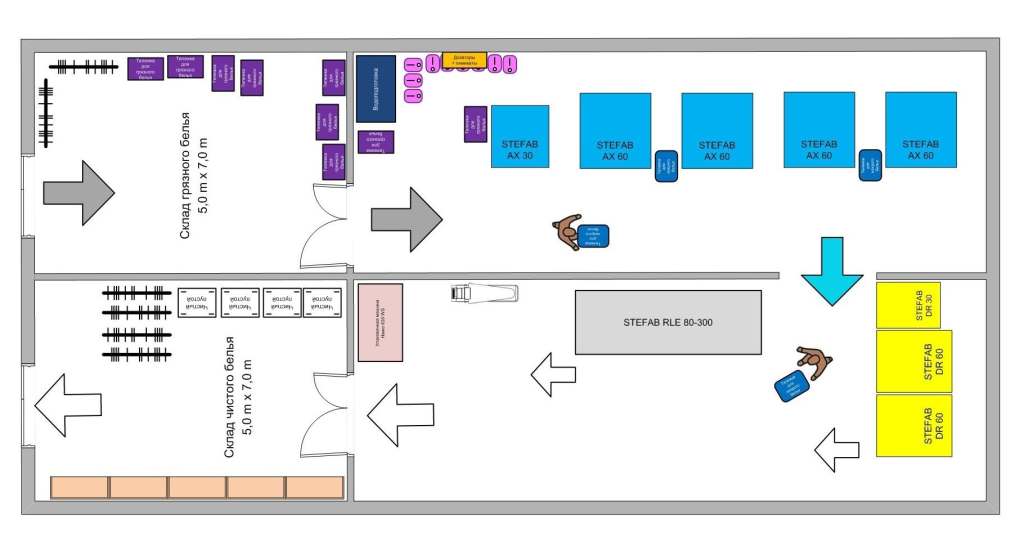
This is what a laundry room like this might look like in an optimal circular layout. The total area, including intermediate warehouses of dirty and clean linen, is 210 square meters, without warehouses - 140 square meters.meters. It should be added that the transition to modern blended workwear made it possible to get rid of the wet-heat treatment of molded linen. To make sure, they left only one ironing table for this. In general, the premises of the renovated laundry have become much more free.
Previously, steam was the main energy source in the laundry. But since steam was generated by an electric steam generator, the customer was asked to completely get rid of it (as an unnecessary link) and switch to electric heating completely, eliminating unnecessary losses in steam lines and the cost of their maintenance. Nevertheless, it was decided to leave the steam generator and install washing machines with combined steam-electric heating (they allow you to use either steam or electricity for heating), and install electric drying drums and a wall-mounted ironing calender.
The composition of the main equipment of the reconstructed laundry:
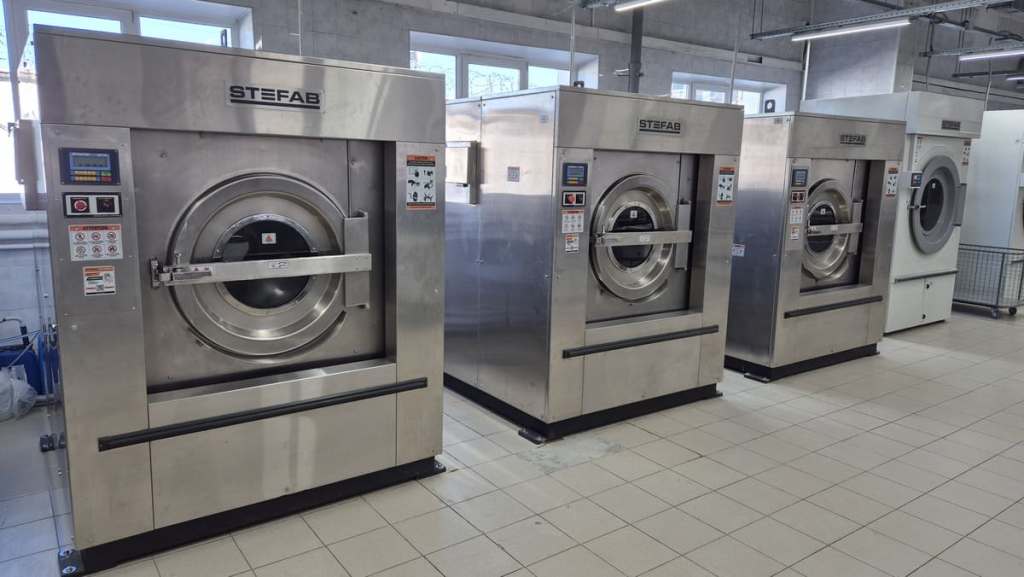
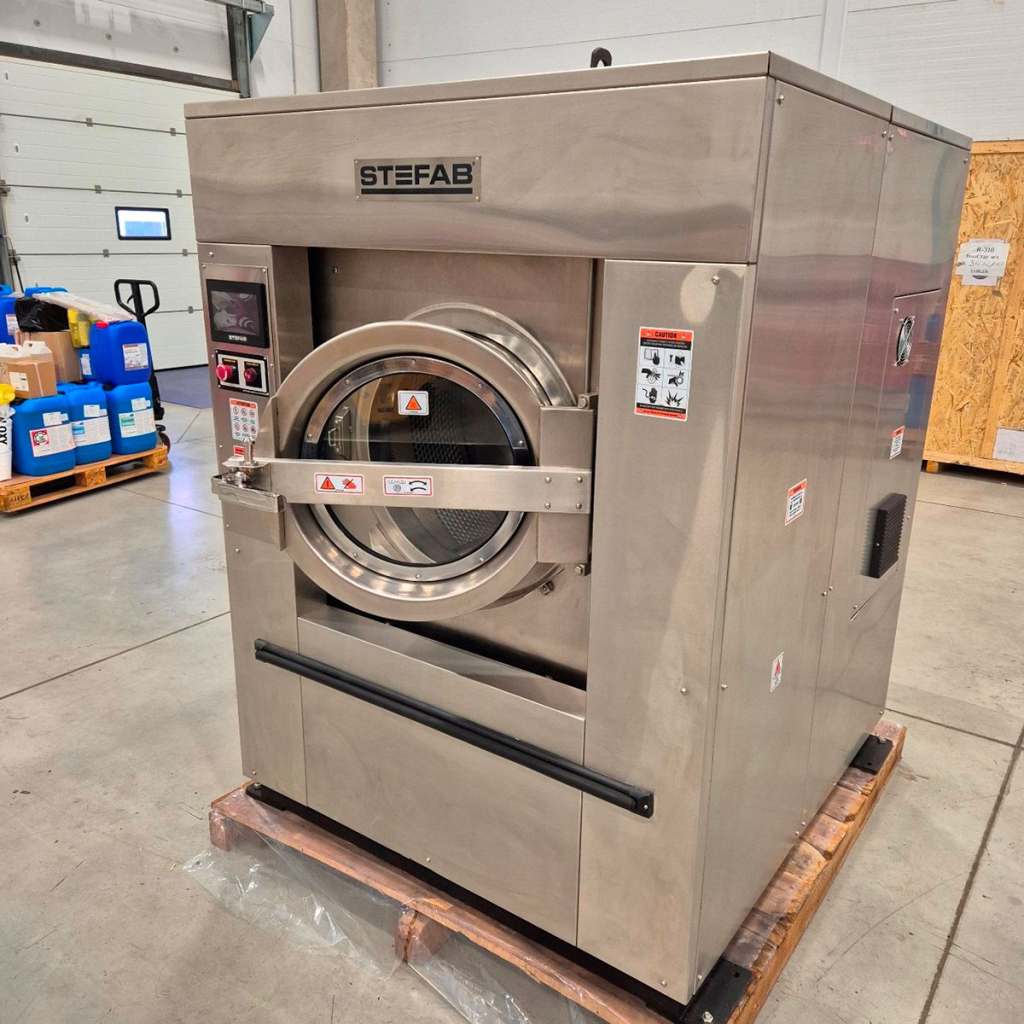
- STEFAB AXSE 60 washing machine – 4 pcs.;
- Washing machine STEFAB AXSE 30 – 1 pc.;
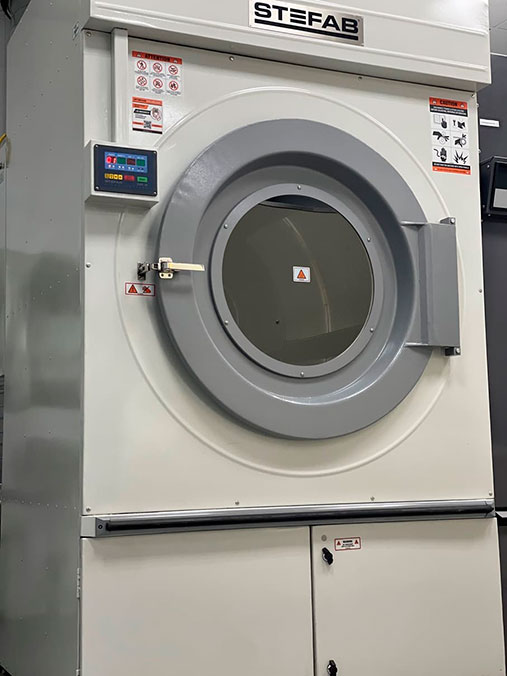
- Drying drum STEFAB DRE 60 – 2 pcs.;
- Drying drum STEFAB DRE 30 – 1 pc.;
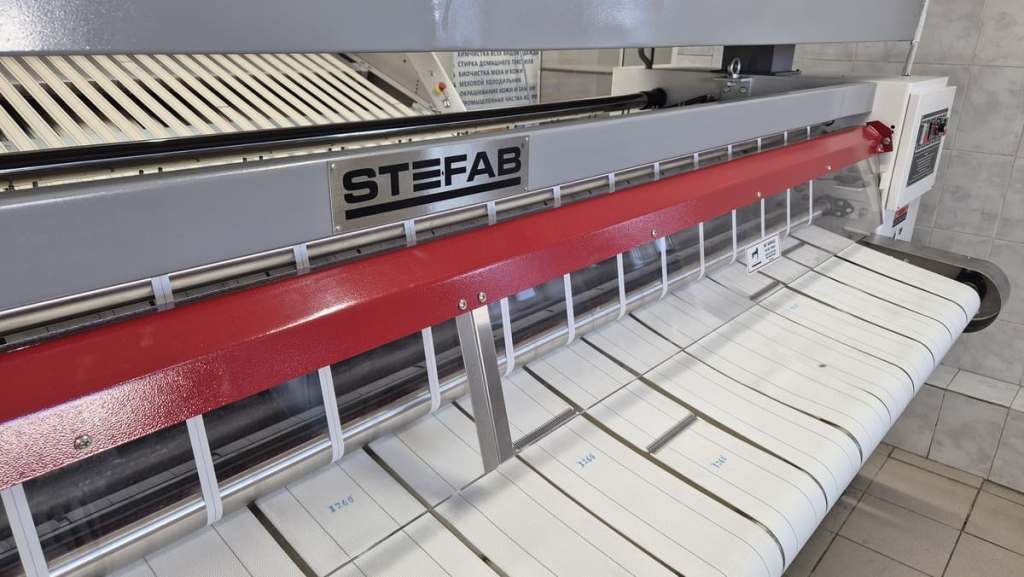
- Wall–mounted ironing calender STEFAB RLE 80-300 - 1 pc.
In the next part of the article, we will take a closer look at the principles of calculating and selecting equipment for modern laundries.
For more information about everything related to laundry or dry cleaning, you can always contact our experts in the world of TEXKEPRO solutions.
TEXKEPRO Company
bodys.: +7 (800) 222-57-55
info@texcare.ru
www.texcare.ru
Documents
