


How to design a laundry room correctly. Part 2

In the first part of the article, we touched on the general principles of organization and design of laundries. Let's discuss more specific issues now. In particular, the issues of forming technical specifications for potential suppliers, analyzing their commercial proposals and the rules for selecting washing shop equipment.
How to do it right, says Dmitry Kolotkov, manager of industrial laundries and product manager at STEFAB at TEXKEPRO.
GENERAL PRINCIPLES OF CALCULATION AND SELECTION OF EQUIPMENT
Of course, any investor would like to save on capital investments. And many of them, despising the wisdom of generations, like that fat forehead priest from Pushkin's fairy tale, are chasing cheapness. To wash exactly according to the calculation, to dry more than to wash, to iron more than to dry. It's not exactly a mathematically correct formula, but it conveys the idea correctly. So where do I start?
The length of the laundry day
This is the first fundamental issue. You already have an accurate idea of the required daily processing capacity of laundry, its types, composition and nature of contamination. But we need to decide what the length of the working day will be and, consequently, the number of line staff.
There are generally two main schedules. "This" is an 8-hour work shift on 5 working days a week ("five days") and a 12-hour shift in the rhythm of two working days and two days off ("two in two"). The first one is usually those enterprises that have obvious problems with hiring staff who are ready for intensive work. In this case, if you do two or even three shifts, you will have to put up with the fact that the equipment will be idle on Saturday and Sunday, and then you will need to spend more on its purchase.
The second schedule assumes that the equipment does not have days off, and if there is a second (night) shift, there will be no downtime. Obviously, with this rhythm of work, the required amount of laundry can be processed with less equipment/capacity. The flip side of such a schedule is the accelerated consumption of equipment resources. You also need to understand that with machines running around the clock, you don't have any reserve time for technical needs, whether it's routine maintenance of equipment, or, unfortunately, sooner or later unavoidable malfunctions.
It should be noted that night shifts usually work without the supervision of a technologist and a laundry manager, which hardly contributes to high labor productivity and high quality. A reasonable option for using a night shift schedule is when all responsible and complex laundry is done during the day (under the supervision of a technologist), and a simple assortment is processed at night. It is also reasonable to handle straight linen (bed and restaurant) during the day, which requires the operation of ironing equipment (and their operators, respectively), and at night to wash only terry cloth and overalls (without ironing, only washing and drying).
In my opinion, the most reasonable and balanced option for organizing a laundry is a one-shift twelve-hour day (2 shifts of operators). It allows, if necessary, to vary the laundry capacity within wide limits without changing the composition of the equipment. On the one hand, it can be doubled, as a maximum, by switching to two 12-hour shifts (4 shifts of operators) or, conversely, go for a single shift (8 working hours) five-day shift.
ISO OR DIN STANDARD? NO, I'M NOT!
I want to immediately remove the question of how to calculate and then compare offers made on different brands and models of equipment? But there's no way, I'll answer. The fact is that if you do not make obviously incorrect comparisons of equipment from diametrically opposite poles of quality, for example, the Swiss Schultess with, let's say, budget equipment, then it will be unlikely to encounter a noticeable difference in the actual performance of machines, all other things being equal.
Yes, characteristics such as water consumption, I emphasize, on standard programs and the specific heating capacity really affect the performance of machines. Yes, more powerful heaters (heating elements) will speed up washing, but even this is offset by the ability of smart machines to mix hot and cold when supplying water so that it would practically not take time to warm up.
And, most importantly, in real life, few people erase using standard programs. Now a washing machine is a CNC machine that works the way a person programmed it, obeying only the technological difference between the preparations used and the washing technologies. And here, by the way, the most important characteristic of the technological process of washing "pops up" – the quality of the preparations and the qualification of the technologist. But this is another deep topic.
Unfortunately, the realities of the modern world are such that some equipment manufacturers, indicating such seemingly serious characteristics as machine performance, water and energy consumption, do not bother to indicate under what conditions certain figures were obtained. The standards of these measurements are not specified. That is, all the parameters that significantly affect these characteristics can be any! This means that marketers can "draw" any interesting numbers of characteristics.
Unfortunately, some seemingly inconspicuous but obvious technical characteristics of machines can "tell" more about the equipment than a whole colorful glossy booklet. You just need to be able to correctly understand and interpret these characteristics based on the priorities and prose of your particular laundry. Thus, I urge you to be realistic and compare only what is objectively comparable. And, moreover, do not take the word of the unfounded claims of suppliers about the superiority of their equipment, including those coming from various gurus and luminaries of the industry.
Technical specification for the calculation
We should try to calculate the number of washing machines accurately. If you invest more, it's just an overspending of the budget. And if it's less, then the laundry simply won't be able to cope and you'll have to lengthen the work shift (additional permanent staff costs). And we will not talk about the options for artificially "speeding up" washing by reducing quality – lower temperature and time.
And then a new pitfall awaits us. In the sidebar, I have already mentioned the modern lack of serious technical characteristics of the equipment. Unfortunately, lawlessness often begins with the main characteristic of a washing machine - its nominal load. The fact is that decades ago it was customary to define it in kilograms as the volume of the inner drum of a car in liters divided by 10. A car with a drum volume (not a tank!) of 220 liters was considered 22 kilograms.
That is, a 100 kg machine should have a drum volume of 1000 liters. 1 to 10 and nothing else. Nowadays, manufacturers often mislead inexperienced consumers by indicating the load of the machine with a coefficient of 1 kg per 9 liters. That is, a 1000-liter car becomes 111 kg with a stroke of the pen, or, if you "round up" a little, even 115 kg!
But that's not all. It is not for nothing that a conscientious supplier finds out before calculating which type of laundry, its composition, type and degree of contamination must be treated. The technological load factor of the machines and the duration of the washing cycle will depend on them. In reality, it can be 0.8 on average for a hotel range of underwear, 0.7 or even 0.6 for heavily soiled workwear. And when calculating, it is absolutely impossible to ignore the average technological coefficients and the realistically achievable duration of washing cycles.
So what should the correct technical specification look like for calculating a set of equipment? As an example, let's calculate the number of washing machines for the hotel range.
Initial data for calculating the basic laundry equipment of a Class 4+ hotel complex*:
- The load of the main laundry is 2,500kg/day (75 tons per month);
- The needs of mini-cleaning and equipment for processing guest linen are not taken into account;
- Working day – daily, 1 shift of 12 hours (10 washing cycles maximum, taking into account the assortment and subject to the use of automatic laundry technologies Kroisler, Germany);
- Linen – hotel assortment (bed, 10% restaurant, 30% terry cloth), average pollution, technological load factor 0.8 , sufficient working width of the ironing machine 3.3m;
- The equipment is electric heated, there is soft cold and hot water (T = 60-70aboutC), as well as water with normal hardness (5 - 7dH);
- Automatic dosing of professional chemicals using a central station;
- There are no other technical or technological features.
How many washing machines and which ones?
In order to get the total passport load of washing machines, we need to divide the actual daily amount of laundry (2,500 kg) by the maximum possible number of washing cycles, which can be completed in 12 working hours, taking into account a specific assortment and a specific washing technology (preparations). Taking into account the German Kreussler chemistry and its automatic dosing, we will be able to provide 10 washing cycles per shift – that is, 250 kg/cycle. And now we need to apply the technological load factor of 0.8 to the resulting figure. We get that the total NOMINAL load of the equipment should be 250/0.8 = 312.5kg.

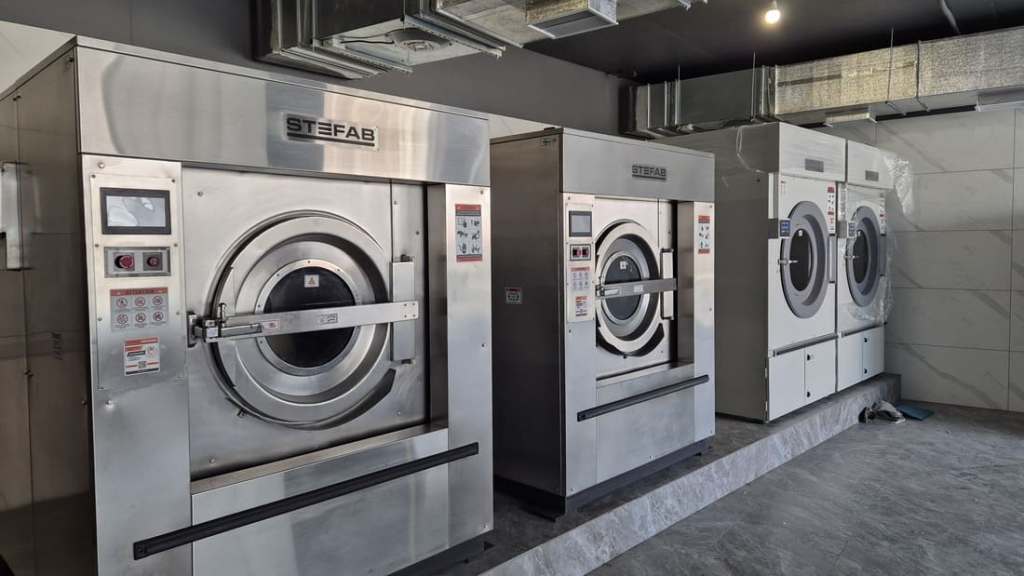
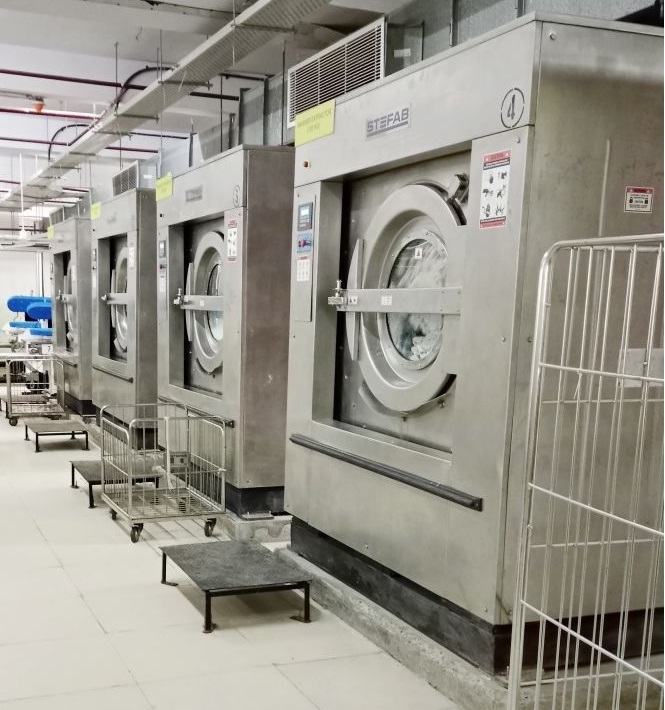
The STEFAB equipment set is ideally suited for this figure, consisting of AXE 60 (4 pcs.) + AXE 30 (2 pcs.) + FXE 15 (1 pc.) machines – a total of 315 kg of nominal load.
And here it is necessary to explain why there are such numbers of such downloads. First. The axiom is that a machine with a larger load (in this case 60kg) will always wash better, faster and more economically than two machines with a smaller load. Second. The cost of a 60kg machine will be less than the cost of two 30kg machines. And third, it will take up less space and require fewer manual operations per download unit. That is, higher-capacity machines are preferable in all respects compared to smaller ones.
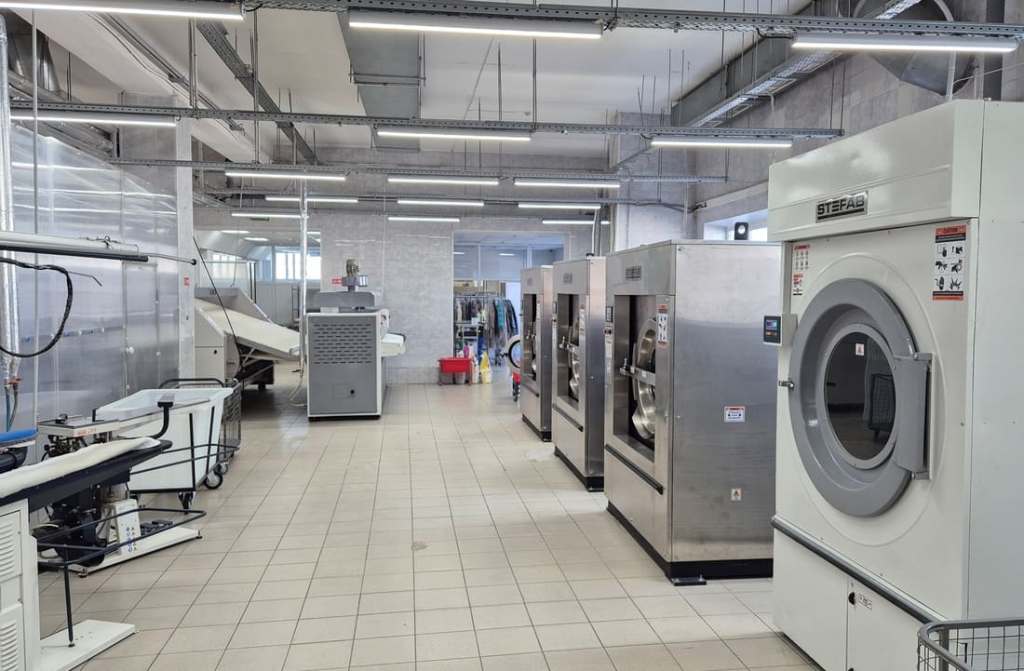
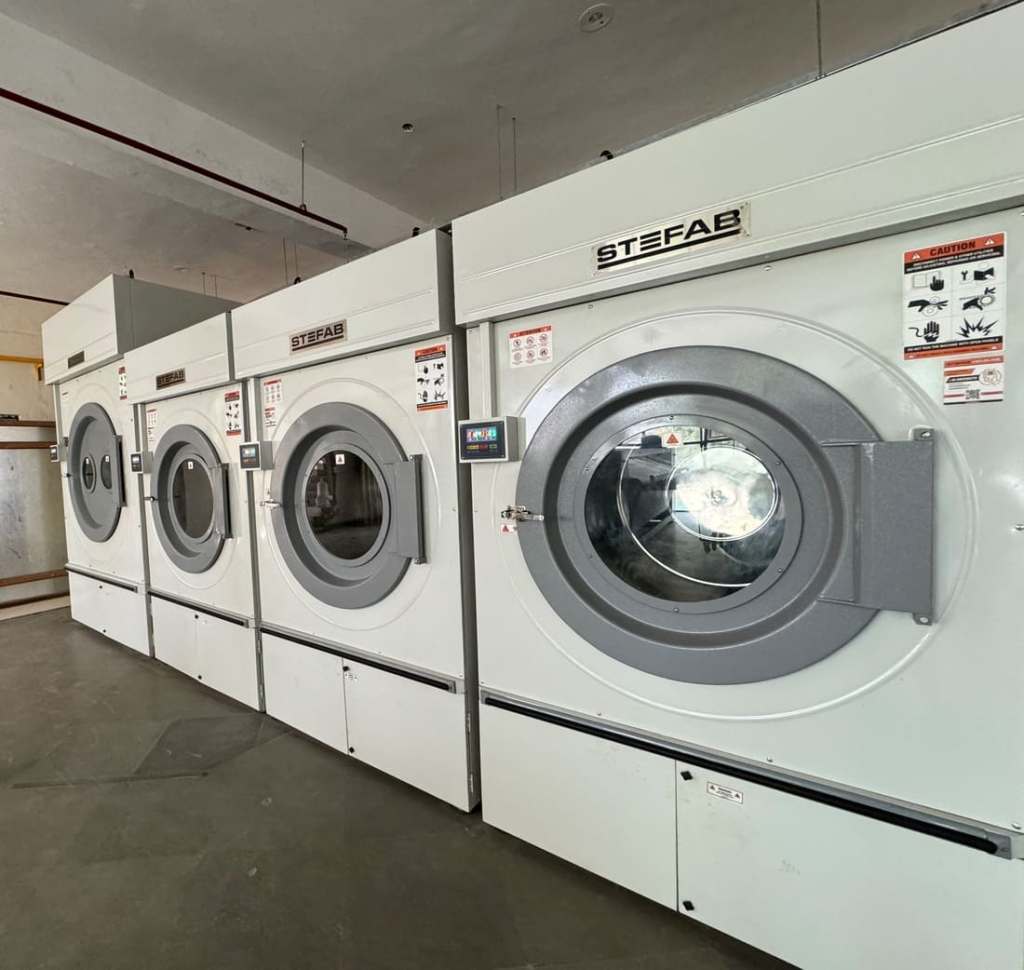
On the other hand, the general flow of laundry in any laundry room is divided into separate technological streams. In the same hotel laundry, it is possible and necessary to sort laundry and organize optimal technological chains of laundry processing. For example, even monochrome bed linen can be divided into sheets, duvet covers and pillowcases, and terry cloth into bathrobes, face towels and separate foot towels. Without going into details about why and how best, it is clear that smaller machines may be required for optimal processing in full-load machines (this was discussed in the first part of the article). For example, for retouching or separate treatment of a heavily soiled part of the entire laundry range.
Then, when forming a set of equipment, the laws of mathematics dictate the use of half-load machines. This is the principle of dividing a segment in half - the optimal iterative method for approximating the solution of an equation. In our case, the solution to the equation is how to process a certain amount of laundry in the most optimal way. In general, the solution to this problem looks like this. A laundry room should have several (most) main-load machines, one or two half-load machines, and one (rarely two) quarter-load machines. As an example for clarity: 40kg (4 pcs. basic) + 20kg (2 pcs. half load) + 10kg (1 pc. quarter). In a real laundry, of course, small professional machines with a load of 6 – 8kg will also be added, but they are already outside the calculation brackets of the main equipment.
All of the above regarding the choice of a set of washing machine loadings is exactly true for any OPL laundry (again a reference to the first part of the article). Unfortunately, this can not always be applied to another mass type of laundry – commercial. If an OPL within a large enterprise, for reasons of economics of the entire enterprise, can and should set up the delivery of laundry and its pre-sorting in the most optimal way, then a commercial laundry can have little influence on its customers, who can arrange a orgy of batch size, assortment and degree / type of contamination. But even this, in my opinion, is a debatable issue and is in the field of business organization.
And, in conclusion, a little trick that should not be neglected. At the beginning of our calculation, based on technological realities (laundry-pollution-preparations), we determined the maximum possible number of washing cycles (10 per 12-hour working day). So, in order for the entire laundry to make a guaranteed plan for the day, it is necessary to shift the shift of washing machine operators an hour earlier relative to the start of the shift for ironing equipment operators. That is, by the time the ironing operators go to work, the first batch of laundry will be ready for them.
We will talk about the specifics of the selection of drying and ironing equipment in the next part of the article. In any case, the professional opinion of our experts, both on the technological issues of washing, aqua cleaning, stain removal and dry cleaning, as well as on the optimal choice of equipment for them, you can always get the right TEXKEPRO solutions in the world.
TEXKEPRO Company
bodys.: +7 (800) 222-57-55
info@texcare.ru
www.texcare.ru
Documents
