Laundry Economics
Often, various enterprises such as hospitals, hotels, industrial enterprises, and sports clubs raise the question of whether it is worth organizing your own laundry or continuing to use the services of third-party commercial organizations. And the answer to this question is not as obvious as it might seem at first glance.
Dmitry Kolotkov, manager of industrial laundries and product manager of STEFAB at TEXKEPRO, will help you understand the topic.
OWN LAUNDRY ROOM. why?
Enterprises' own internal laundries (OPL) are created for several reasons. This:
- The desire to reduce the cost of laundry (its processing at cost) plus the desire to earn money on laundry for other organizations as a commercial laundry;
- Dissatisfaction with the quality of work of existing third-party laundries;
- The inability to use the services of a third-party commercial laundry;
- The need for full control over the quality of washing and finishing of laundry;
- The importance of ensuring the correct (gentle) technical process of laundry processing in order to maximize its life span and/or preserve its special properties (oil and water protection, antistatic properties, reflective tapes, etc.).
Naturally, in the case when it is not possible to use outsourced laundry services, the issue of economics can no longer be considered. Laundry is needed in this case anyway. But, as a rule, the main reasons are motivation for the first two of these points. Thus, the issue of payback for the future OPL division is immediately raised.
Obviously, you need to compare the average daily (monthly or annual) costs of third-party laundry with the corresponding average cost of your own laundry. If, by subtracting the second digit from the first, we get a positive number, then our own laundry will be beneficial to the company. If the result is negative, then your own laundry will be more expensive than an outsourced one. But even in this seemingly negative case, additional reasons of a different nature may appear as arguments for your own laundry. This is the quality of laundry washing while ensuring gentle processing modes. It is much more difficult to make a decision here, but expert opinion is that a rarer purchase of expensive linen (it does not matter if it is overalls, terry cloth or bed linen) will more than cover this negative difference.
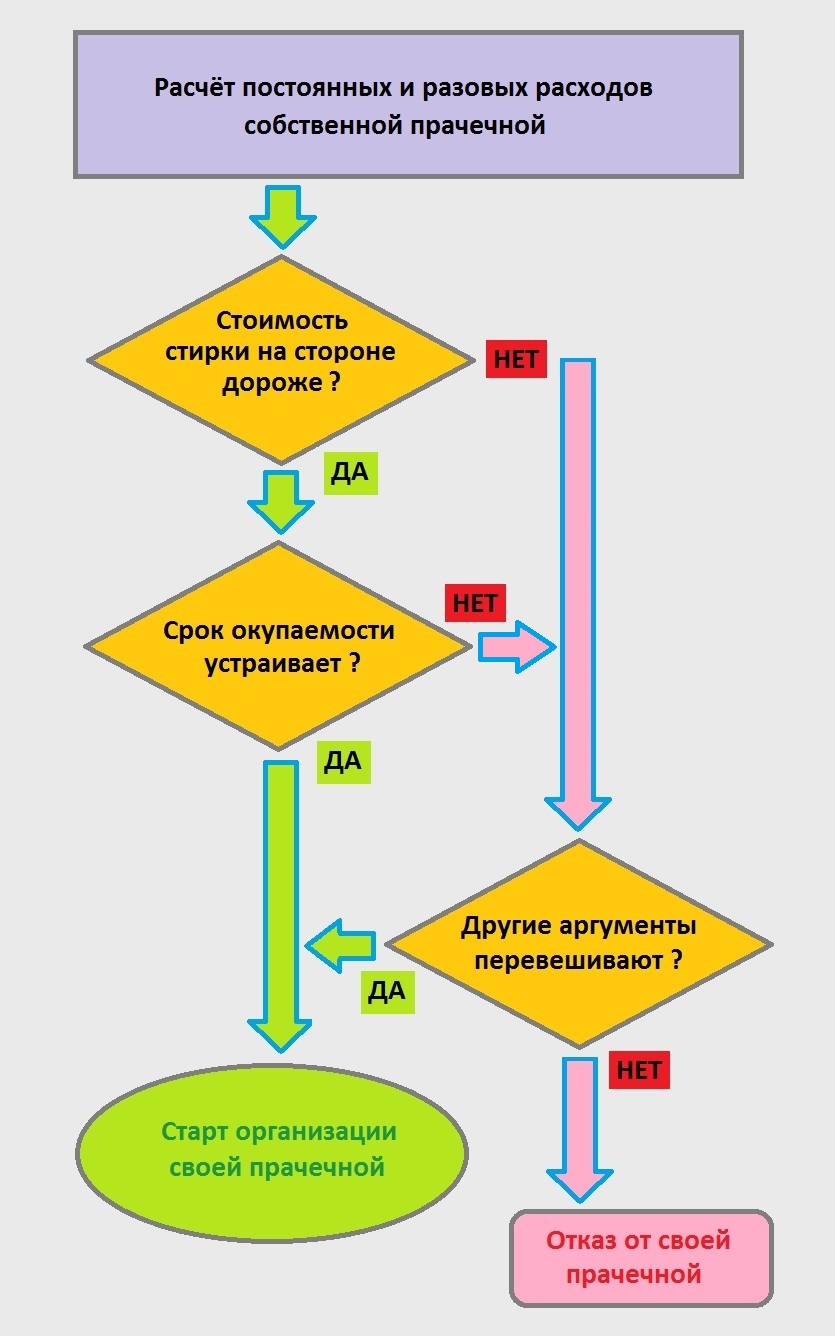
In general, the algorithm for making an economic decision to install your own laundry at an enterprise looks like this:
- Estimating the fixed costs of running your laundry;
- Assessment of payback (taking into account one-time initial expenses, such as purchase of the actual equipment, its installation, repair of premises, etc.);
- Making a decision taking into account all the benefits of your own laundry, even in the case of negative ratings in the first two stages.
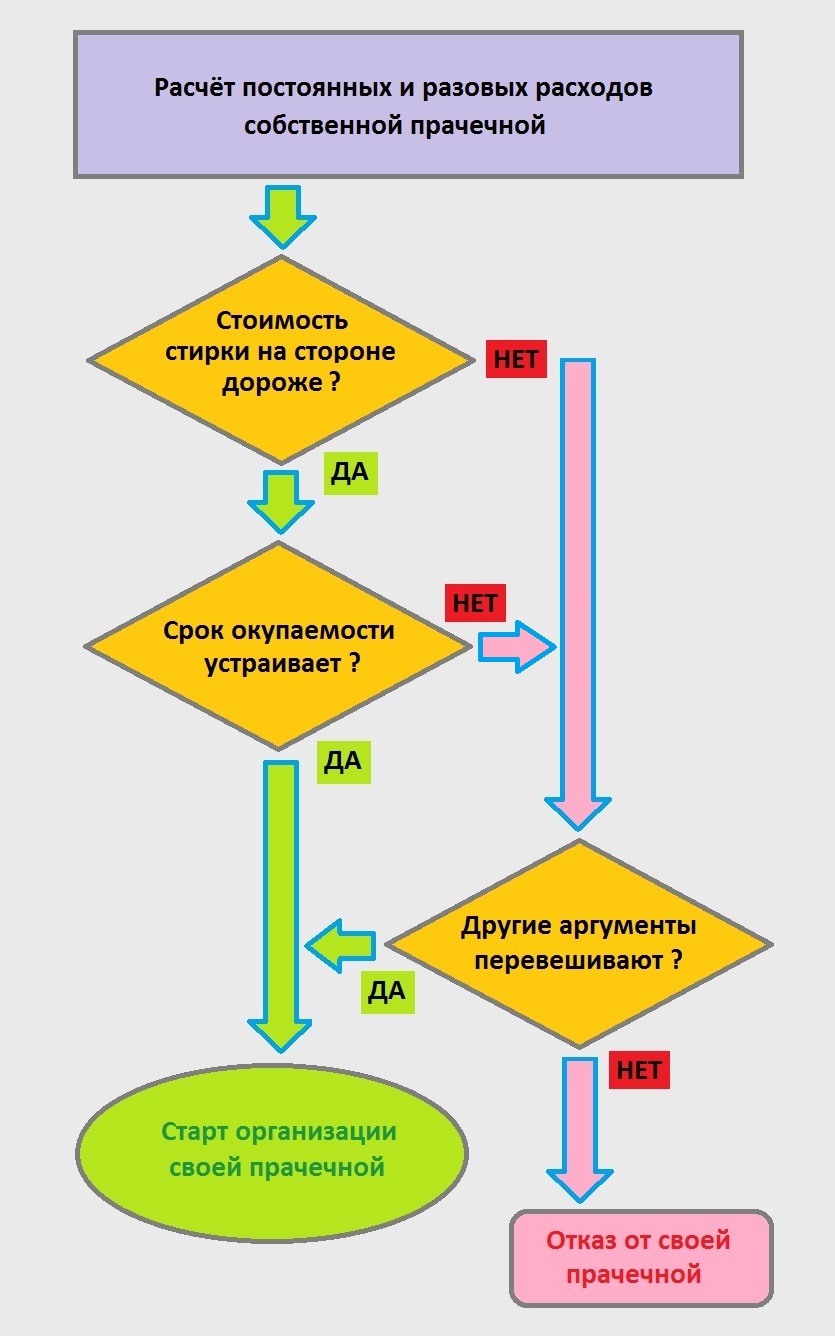
The paradox of logic is that the decision to organize your own laundry can be made at the last stage, despite the fact that formally, as a commercial laundry project, the company's own OPL will be uncompetitive compared to third-party commercial laundries.
WHAT SHOULD I COUNT AND HOW?
If the figure of outsourcing costs is very easy to obtain in the accounting department of an enterprise, then calculating the second one, as a rule, causes difficulties. Let's think about it together and put together all the costs of our future OPL. I will make a reservation that here and further we will consider the "white" business organization.
The permanent expenses of the laundry will include the following costs:
- Energy sources (gas, steam or only electricity);
- Water and sanitation costs;
- Preparations for washing;
- Regular maintenance of equipment;
- Depreciation of laundry equipment;
- Wage fund (PHOTO - staff salaries and taxes).
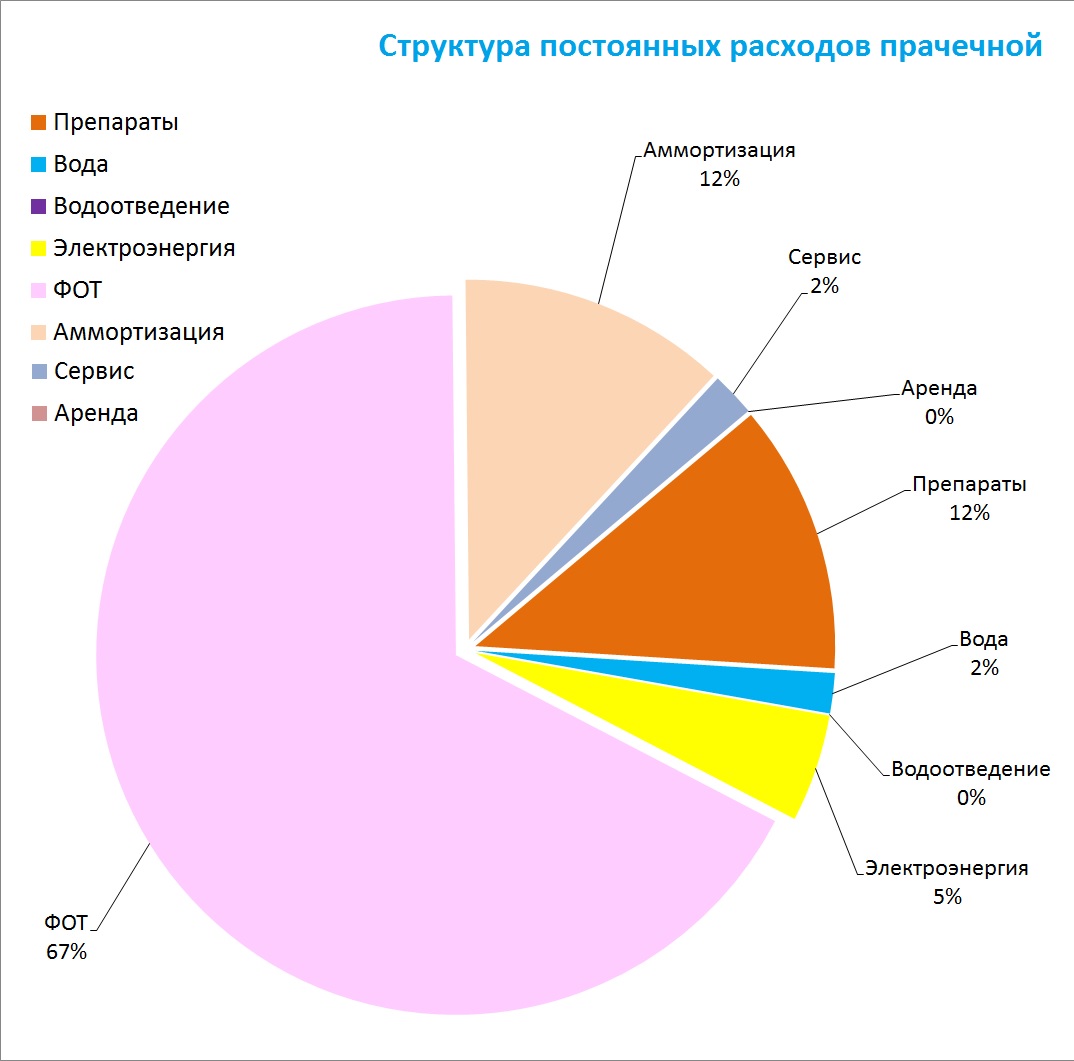
As an example, I can cite a special case of calculating the fixed cost structure of a small laundry of a high-class Moscow hotel that handles only the hotel's own restaurant assortment of linen (without bed linen and terry cloth).
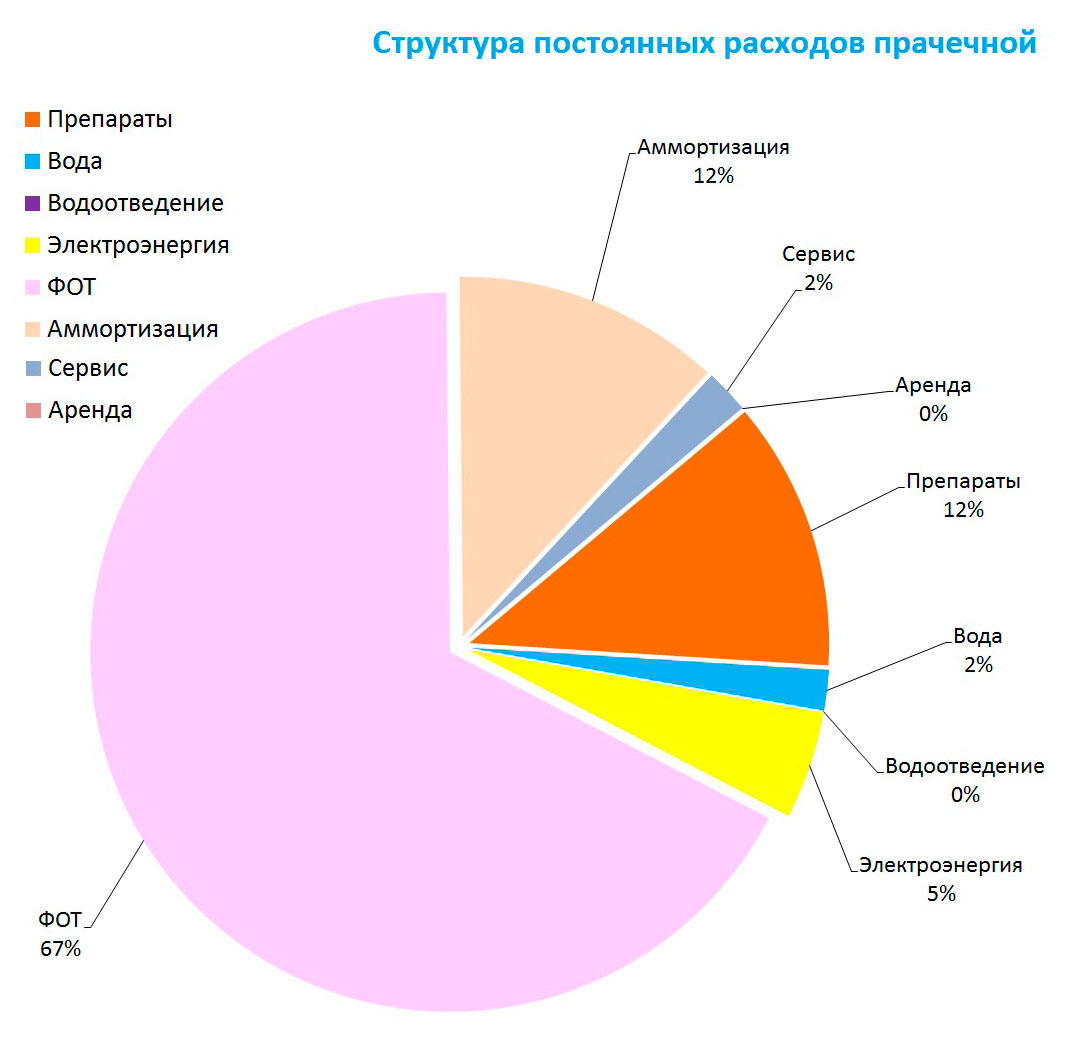
It is clearly seen that the lion's share of fixed costs (67%) is the cost of personnel. It is important to understand that if the laundry schedule is not supposed to be 2 through 2 for 12 working hours, but as a single shift of 5/2 for 8 hours, then the size of the photo will decrease significantly, but the cost of the necessary equipment will increase significantly. That is, it greatly changes (increases) the one-time initial cost of purchasing equipment and significantly reduces fixed costs. In other words, you will first need to spend a large amount on more productive laundry equipment, but then you can significantly save on fixed costs. This requires a fundamentally important decision by the owner, which significantly affects both the first and second steps of decision-making. A nice little bonus of switching to higher-load machines is that they wash faster and more economically than their smaller counterparts, but they need more space and sometimes they are more difficult to "stuff" into existing rooms.
Next in terms of weight is the depreciation of equipment. Its share could be higher if the depreciation period was reduced. In this case, the term is seven years. Also, the share of depreciation in the cost structure will increase with the transition to a single-shift 8-hour working day, and here we need to look at what is more interesting for a particular enterprise.
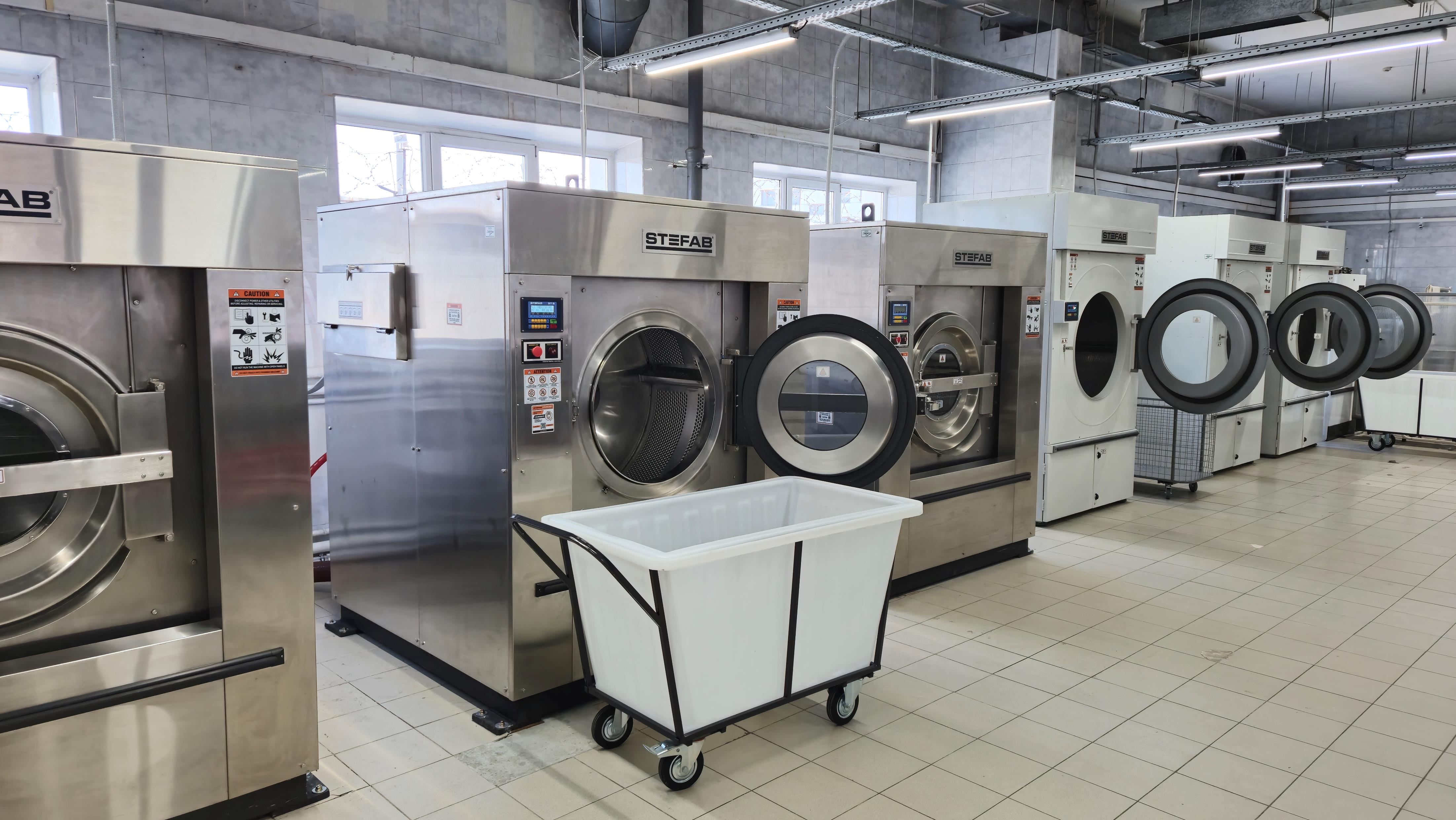
THE IMPORTANCE OF CONSIDERING WASHING TECHNOLOGIES
The next significant share (12%) is the cost of laundry preparations. Here I calculated the rather large dosages of all the Kroisler preparations necessary for perfect washing. It is important to understand that in this example we are erasing the restaurant assortment (strong and complex impurities) and this is one of the most "expensive" washes. The proportion of chemicals, of course, will be lower when processing a simple assortment.
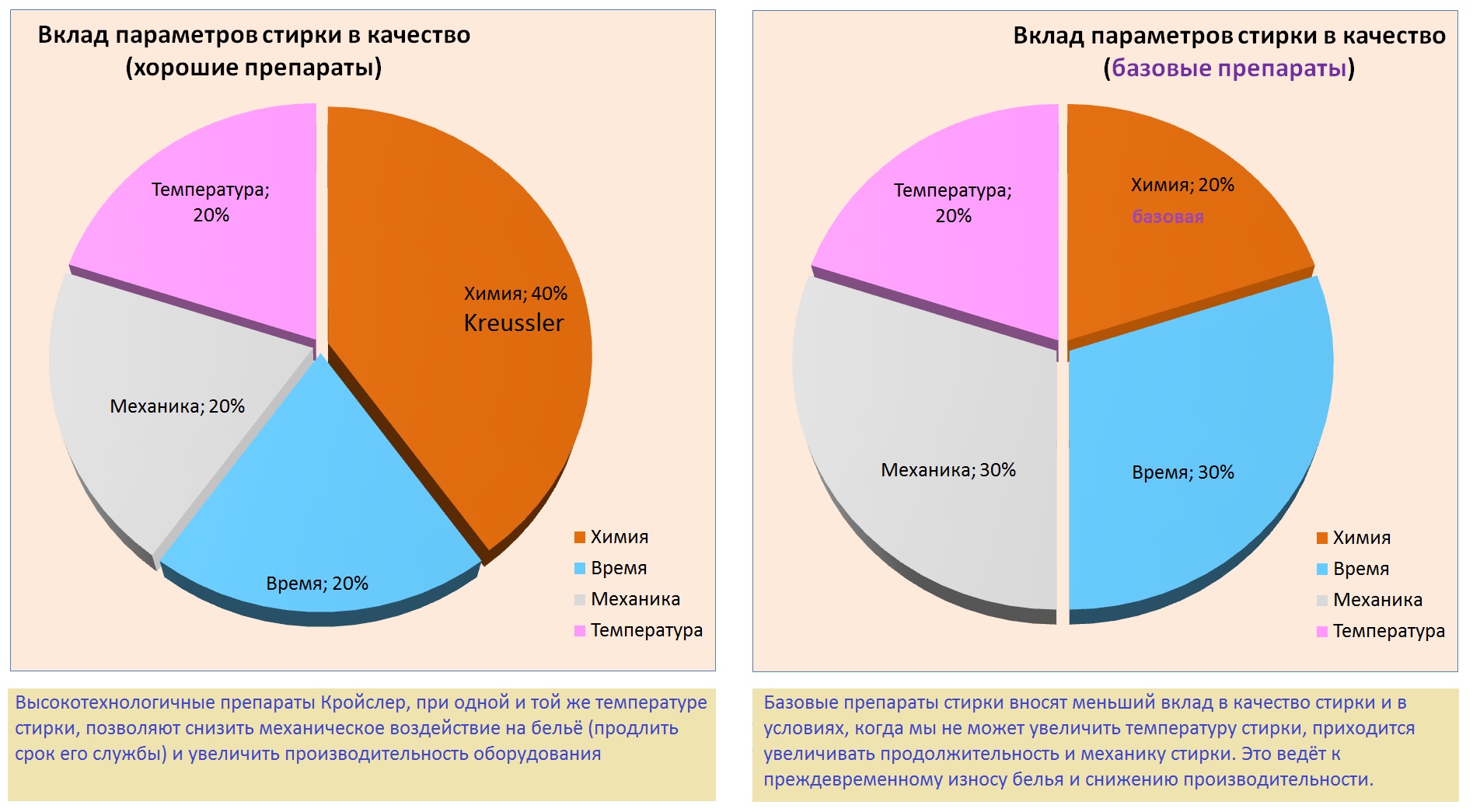
It should be especially noted that drugs (chemicals) are the only parameter that we can really control the quality of washing. If we recall Zener's textbook circle, then we cannot increase the washing temperature above the permissible temperature for these fabrics. We cannot increase the washing time, as the productivity of the equipment will collapse. The mechanics of washing depend on the design of the washing machines themselves (especially on the diameter of the drum), program settings (proportions of the duration of the rotation time of the drum and the pauses between them), and also on the limited total washing time.
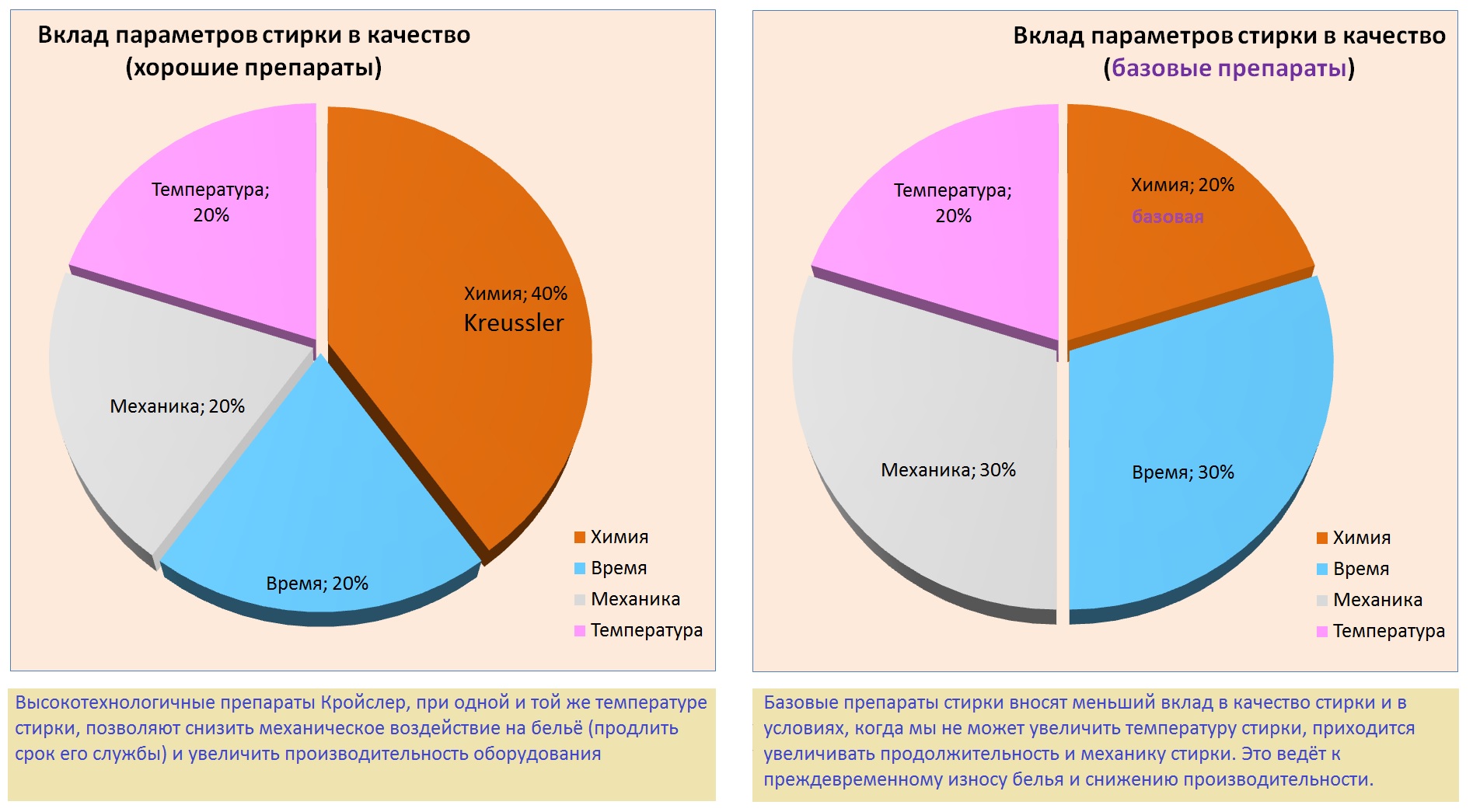
It is important to always keep in mind that savings on dosages and quality of preparations always lead to losses in washing productivity, quality and other costs, which ultimately makes it pointless to own and manage your own laundry.
Striking examples of the use of good preparations are TEXKEPRO's low-temperature safe washing technology using the most modern localized TEXKLIN washing preparations in combination with imported high-tech additives and components for washing from simple "straight" linen to the most complex assortment of workwear and/or down jackets.
The remaining cost categories turned out to be more modest in the total share of fixed costs for the operation of the laundry. However, it is necessary to take into account the fact that for each enterprise, the proportions of costs and their size may vary not only from the specific price level for electricity, water, and personnel costs, but also from the assumptions used and calculation methods that are correct from the point of view of a particular enterprise. As the most harmless example, various industrial enterprises can be mentioned, where hot water and steam are actually waste from the main production, and in this case it is simply stupid to take them into account in the expenditure part of the laundry department.
WHICH OPLS ARE EASIER TO RUN?
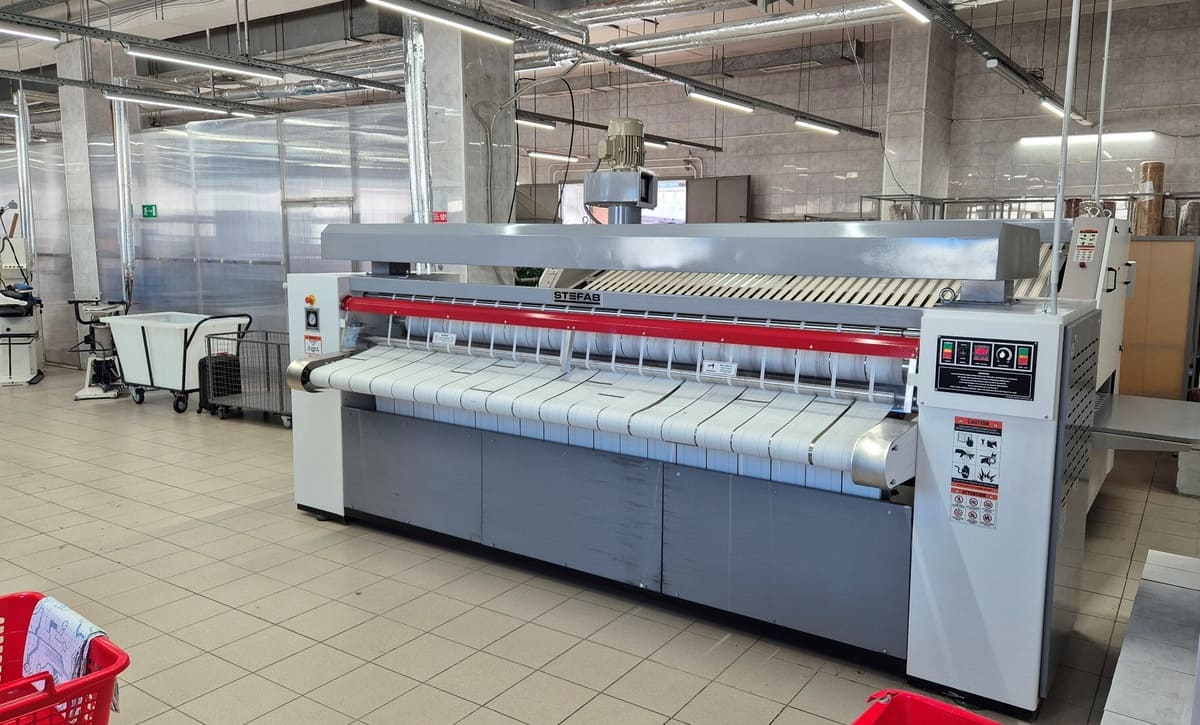
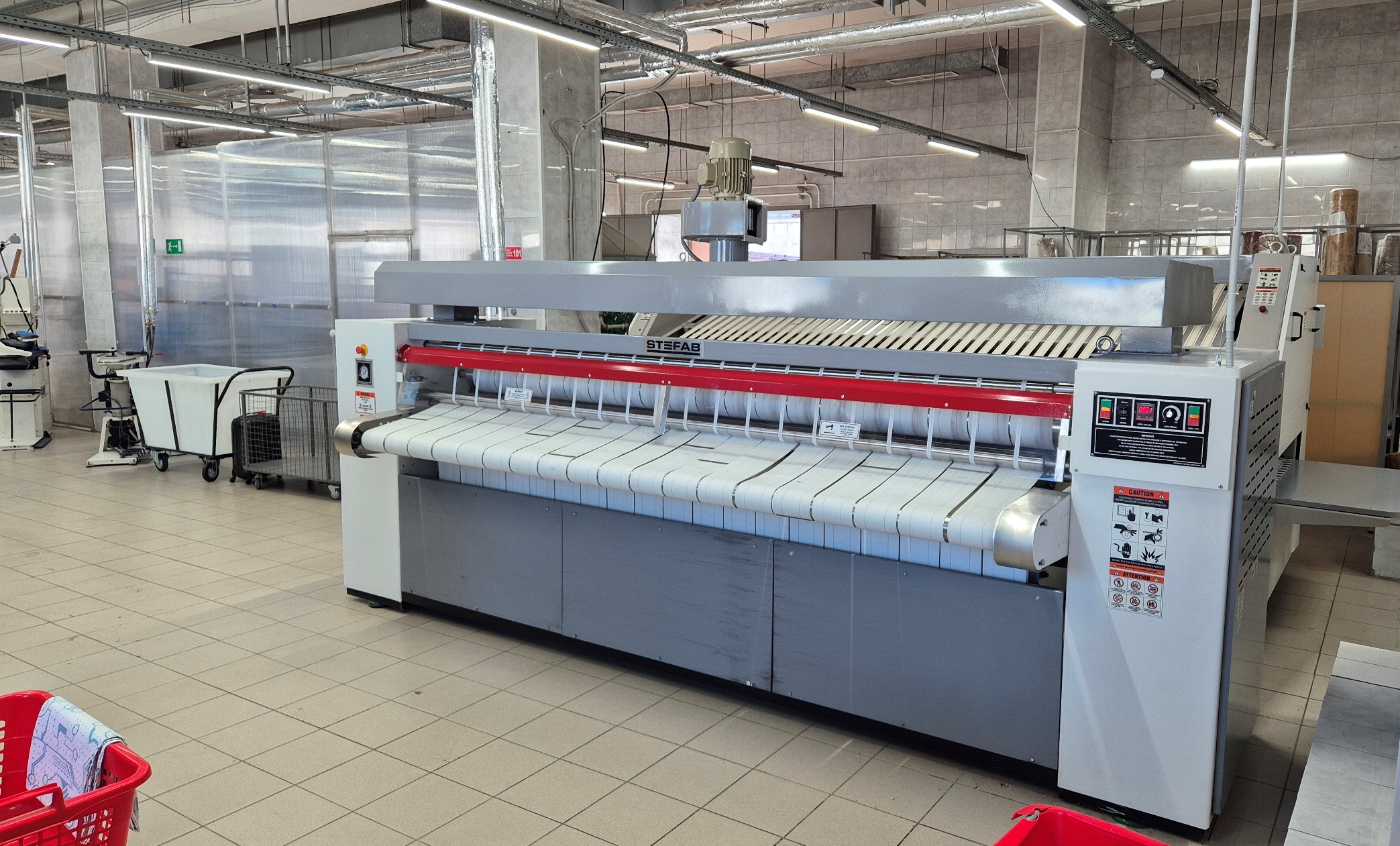
A phased launch will help you make a positive decision about organizing your own laundry. For example, in the HoReCa sector, hotels, sanatoriums, as well as high-class medical institutions may initially not aim at a full-cycle laundry, but first only start washing terry products and a shaped assortment (staff uniforms). These products do not require expensive ironing machines for direct laundry and personnel to work on them – only automatic washing machines and dryers. Here I deliberately ignore such equipment as a stain removal table and an ironing table. Of course, they will fit into the yard in most laundries, but still not everywhere they will be mandatory elements.
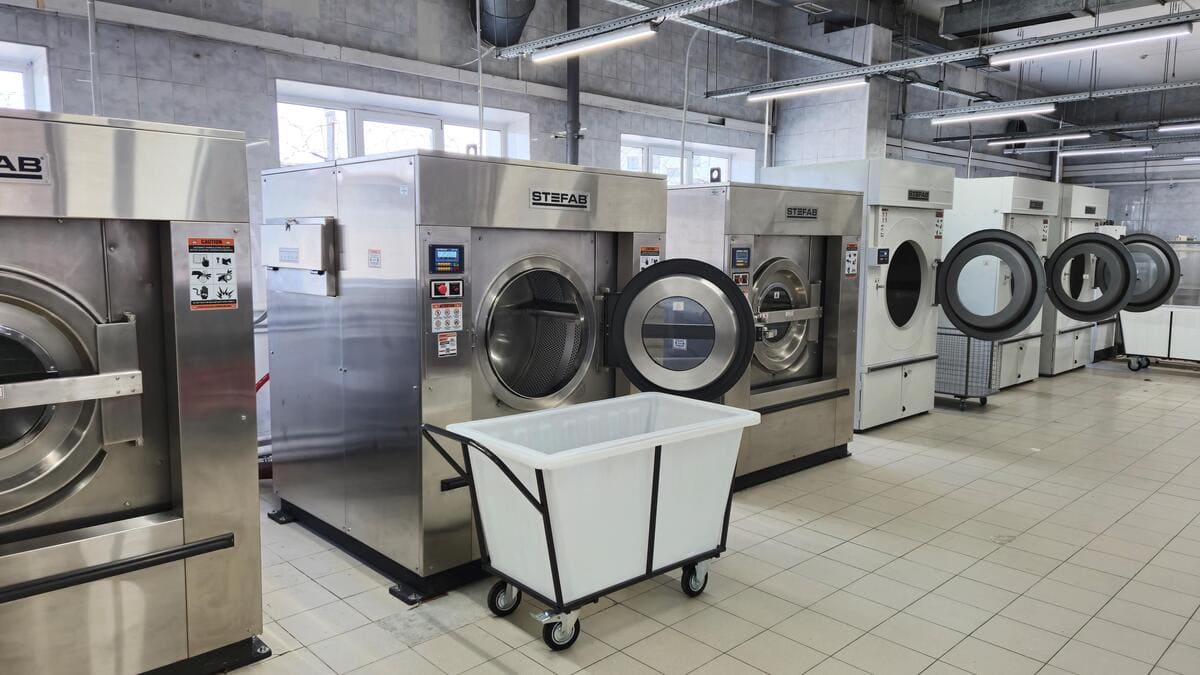
From the point of view of the set of equipment, the simplest ones will be the laundries of sports clubs and laundries for processing work clothes. Washing machines and dryers only. Yes, workwear and its contamination are often not a simple assortment from the point of view of processing technology, but what difference does it make to you if you are aiming for the use of automatic high-efficiency integrated Kroisler technologies? All the work on setting up technologies has long been done by the technologists of the chemical manufacturer, and in your case, it is the responsibility of TEXKEPRO technologists to implement it in the most correct way.
In general, if the decision on the necessity and desirability of your own laundry is almost made, then in the next part of the article we will look at the nuances. OPL payback estimates and technical capabilities its implementation.
Unfortunately, many points in the article could only be covered in a summary, without a detailed explanation of "why this is so." But you can always discuss any issues related to the organization of laundry, the choice of equipment, and the use of the best technological solutions for washing, aqua cleaning, dry cleaning, and stain removal with our experts in the world of the right TEXKEPRO solutions.
Dmitry KOLOTKOV,
TEXKEPRO Company
bodys.: +7 (985) 992-79-76,
www.texcare.ru
Gallery