


- Main
- About the company
- News
- Company News
Aquachistka - since 1991!
22/07/2014
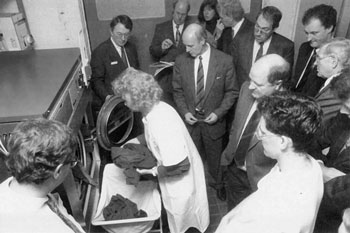
At a press conference on December 3, 1991, we introduced the technology of aqua cleaning to the professional public for the first time. In his opening speech at the conference, Dr. Detlev Travers described the essence of the collaboration between the two traditional family companies Miele and Kreussler.
Over several years of research, we have developed basic methods to protect natural fibers that swell in water and clean with significantly reduced mechanical impact. For this work and for the discovery of the principle that alternating short intense exposure with "relaxation" stages during the cleaning process makes it possible to protect the fibers from damage as much as possible, especially when cleaning wool products, Kreussler received the European patent 0 468 242 A1.
The relevant technological conditions for aqua cleaning were outlined at a press conference by Dr. Helmut Krussmann, who collaborates with the Krefeld Laundry Research Institute (WFK), where, as part of a research commission with the support of the AiF, the principle of separation between washing of thin (light) fabrics and chemical cleaning was developed for us.
Our research is based on the results of serious international work to study the imminent toxicological danger that volatile halogenated hydrocarbons pose to nature and humans. In particular, solvents popular at that time, such as chloroform, carbon tetrachloride, methylene chloride, trichloroethylene and perchloroethylene used for dry cleaning, as well as chlorofluorocarbons used in many fields, in some cases had a very negative impact on living beings, plants, air, water and soil. Therefore, we started a comprehensive search for alternatives to perchloroethylene (P) and chlorofluorocarbon (F) for textile cleaning.
When Greenpeace organized a public action against dry cleaning companies in residential areas in 1988, and when it became clear at the international solvent conference in Amsterdam in 1989 that a completely safe method of using perchloroethylene was impossible in principle, German lawmakers drafted "2. BImSchV" (federal emission control law), which sets limits for dry cleaning.
At that time, it was already clear to us that aquachist was better than any other solvent-based method, not only by reducing the toxicological effects on humans and nature, but also due to the higher quality of cleaning, increased hygiene, absolute safety of use and favorable cost.
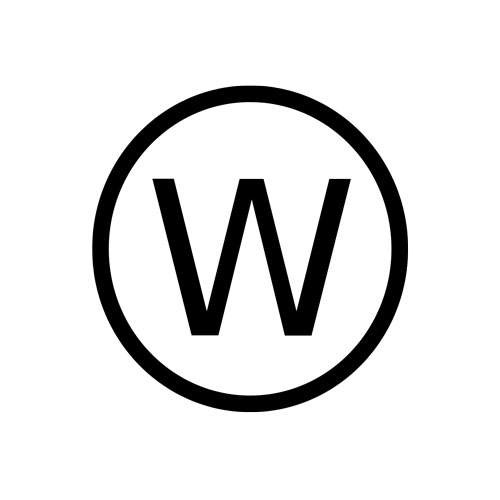
Although some people laughed at us when we proposed our aquachist concept, time has shown that it is well accepted in the market and today it is even marked with its own symbol on the label (W).
Evaluate all the advantages of the original German LANADOL aquachist-Process with TEXKEPRO!
Over several years of research, we have developed basic methods to protect natural fibers that swell in water and clean with significantly reduced mechanical impact. For this work and for the discovery of the principle that alternating short intense exposure with "relaxation" stages during the cleaning process makes it possible to protect the fibers from damage as much as possible, especially when cleaning wool products, Kreussler received the European patent 0 468 242 A1.
The relevant technological conditions for aqua cleaning were outlined at a press conference by Dr. Helmut Krussmann, who collaborates with the Krefeld Laundry Research Institute (WFK), where, as part of a research commission with the support of the AiF, the principle of separation between washing of thin (light) fabrics and chemical cleaning was developed for us.
Our research is based on the results of serious international work to study the imminent toxicological danger that volatile halogenated hydrocarbons pose to nature and humans. In particular, solvents popular at that time, such as chloroform, carbon tetrachloride, methylene chloride, trichloroethylene and perchloroethylene used for dry cleaning, as well as chlorofluorocarbons used in many fields, in some cases had a very negative impact on living beings, plants, air, water and soil. Therefore, we started a comprehensive search for alternatives to perchloroethylene (P) and chlorofluorocarbon (F) for textile cleaning.
When Greenpeace organized a public action against dry cleaning companies in residential areas in 1988, and when it became clear at the international solvent conference in Amsterdam in 1989 that a completely safe method of using perchloroethylene was impossible in principle, German lawmakers drafted "2. BImSchV" (federal emission control law), which sets limits for dry cleaning.
At that time, it was already clear to us that aquachist was better than any other solvent-based method, not only by reducing the toxicological effects on humans and nature, but also due to the higher quality of cleaning, increased hygiene, absolute safety of use and favorable cost.
Although some people laughed at us when we proposed our aquachist concept, time has shown that it is well accepted in the market and today it is even marked with its own symbol on the label (W).
Evaluate all the advantages of the original German LANADOL aquachist-Process with TEXKEPRO!
